
Government bonds were once again centre-stage last week with yields continuing their upward climb, leading to losses of 1.0% for US Treasuries and 1.3% for UK gilts. 10-year yields rose around 0.2% in the US, UK and Germany.
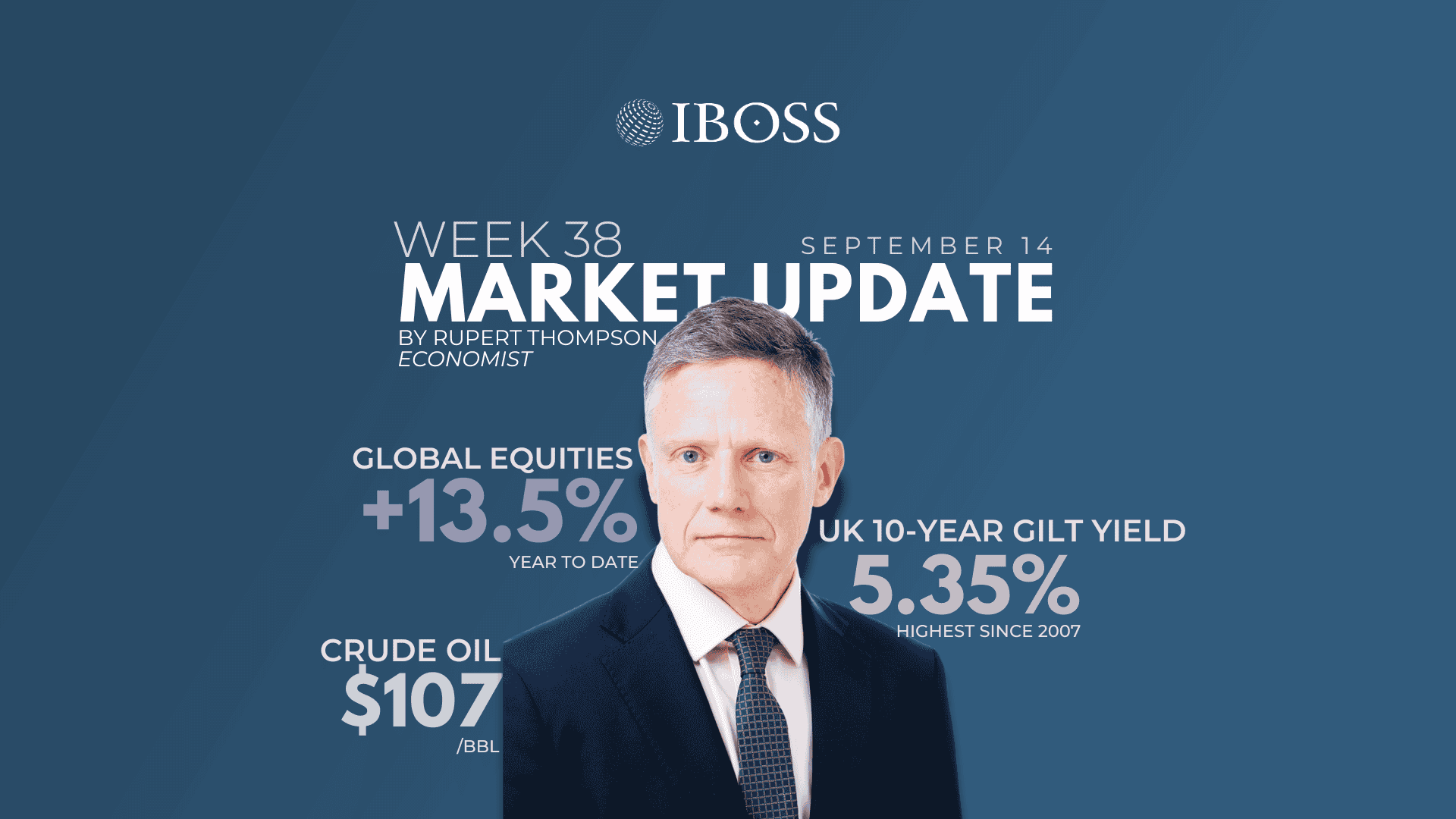
This left the 10-year US Treasury yield at 4.97%, just below the psychologically important 5.0% level touched briefly back in 2023, and the 10-year UK gilt yield at 5.35%, the highest level since 2007.
Equity markets have suffered from this rise in yields although the impact has been quite limited so far. Global equities were down 1.0% last week in both local currency and sterling terms. Emerging markets held up best with a 0.3% decline while the US lost 1.0% and Europe and the UK were both down 1.7%.
The broader picture is that equities have flat-lined over the summer following their large gains earlier in the year. Global equities have returned 0.6% since early June and 13.5% or so since the start of the year – in both local currency and sterling terms.
The renewed intensification of the war with Iran was the biggest factor behind the latest rise in bond yields with the Brent crude price rising $10 or so to $107 per barrel, not that far off the highs of $120 touched earlier on in the conflict.
Increased tit-for-tat attacks by Iran and the US on tankers passing through the Strait of Hormuz have once again slowed shipping traffic, which had recovered somewhat, to a dribble. Equally important, the Houthis have become a major new source of concern. They have been attacking Saudi oil facilities – leading to the closure of a key Saudi oil pipeline – and have also made rapid military advances along the coast of Yemen, effectively gaining control of the Bab al-Mandab strait.
This strait is important because it is both a conduit for Saudi oil production and for container traffic heading to and from the Suez Canal. The good news, if there is any, is that as yet the Houthis are only threatening to attack Saudi shipping.
The other possible silver-lining is that the lesson of the war so far is that only a significant escalation and corresponding hike in energy prices causes sufficient pain to trigger a de-escalation. Indeed, the Gulf States and Iran meet today seemingly with the intention of bringing more widespread support to the Iran-Oman deal to reopen the Strait of Hormuz which was close to being finalised.
The bottom line is that the outlook for the war remains as murky as ever. Bond and oil markets, however, are very much taking the pessimistic view. Crude oil prices are now anticipated to remain as high as $90-95 into early next year. And the market has upped its forecast substantially for the scale of interest rate hikes looming.
The European Central Bank last Thursday as expected raised rates by 0.25% to 2.5% and now expects inflation to remain above target for all of next year. While the ECB gave minimal forward guidance, the market is now anticipating a further rise later this year and two more next year.
More importantly, the US Fed now looks likely to raise rates by 0.25% to 3.75-4.00% this coming Wednesday with a further two or three hikes expected by next summer. Friday’s inflation numbers, along with the rise in oil prices, only reinforced the market’s conviction that given the Fed Chair’s hawkish tone of late, an increase is on the cards on Thursday.
Headline consumer price inflation was unchanged at 3.5% in August while the core rate edged down to 2.4%. The latter is not too far above the Fed’s 2% target but crucially it implies little improvement in the Fed’s favoured core inflation measure which has been running at a rather more worrying 3.3%.
US Treasury yields have been pushed up not only by this shift in interest rate expectations but also by renewed concerns about the poor underlying fiscal position which have only been inflated by the recent actions of the Trump Administration. Having raised the prospect of increased buy-backs of longer-dated Treasuries, Treasury Secretary Bessent’s $6bn buy-back announcement last week underwhelmed the market.
As for Bessent’s recent talk of fiscal consolidation, it had always seemed far-fetched but was shown to be all the more so by Trump’s pledge last week to give every adult American citizen a $5000 cash dividend if the Republicans retain control of Congress in November’s mid-term elections. This would cost a mere $1tn and equate to around 3% of GDP.
This announcement was greeted with scepticism even by some senior Republicans and looks unlikely to see the light of day. It would require Congressional approval and currently the Democrats seem firmly on course to gain control of the House Representatives, even if the Republicans retain a razor-thin majority in the Senate.
Ironically, Bessent has had rather more success recently managing the yen/dollar exchange rate than halting the upward pressure on Treasury yields. The yen has strengthened considerably following the joint Fed/Bank of Japan intervention a few weeks ago. However, the BOJ may need to speed up its monetary tightening if this strength is to be sustained and this coming Friday’s meeting, where it looks set to raise rates from 1.0% to 1.25%, will be watched closely for any clues on this front.
The UK has seen an equally marked rise in interest rate expectations with the market now pricing in rates rising a full 1% to 4.75% by next summer – even if it is forecast to keep rates unchanged at its meeting on Thursday. BOE Governor Bailey last week highlighted the upside risks to inflation and the headline rate now looks set to rise to 4% again, absent any swift decline in energy prices.
Rather more encouragingly, UK growth continues to prove unexpectedly resilient with activity up 0.4% in July and 1.6% on a year earlier. The Budget on 28 October, however, continues to loom large and Chancellor Healey’s speech last Monday shed little light on the affair. While he emphasised that fiscal credibility was indivisible from his quest for growth, it remains far from clear what tax increases or spending cuts will be needed to maintain the fiscal headroom which has been eroded by recent developments, most notably the rise in borrowing costs.
Last week also saw some political developments in Germany with the far-right AFD party garnering 44% of the vote in the eastern state of Saxony-Anhalt. This result highlighted the struggle the ruling Christian Democrats have on their hands although federal elections are only due by 2029. Rather closer to hand is the Presidential election in France next April with the latest polls showing the far right Marine Le Pen the clear leader at least for the first stage of the contest.
And finally, if we hadn’t already had enough worrying news for the faint-hearted, we had warnings that AI could wipe out humanity by the end of the decade. The heads of the leading US AI companies even called for a more cautious pace of development because of safety concerns, only for Trump to reject the calls because of the need for the US to retain its lead over China in this area.
Returning to the here and now and the rather more parochial question of the near-term outlook for markets, our view is that bonds are now pricing in a lot of bad news. Most likely – but it does depend on events in the Middle East – interest rates will not end up being raised half as much as now feared. Back in the spring, markets too were forecasting UK rates to rise to 4.5%, only then to become significantly more relaxed.
This is not to say that bond yields at least short term couldn’t yet rise further. But the loss incurred by any rise in yields needs to be balanced by the fact that bonds offer a much larger buffer now they are yielding around 5%. Longer term prospective returns from fixed income look the highest for twenty years.
As for equities, they could well come under some more downward pressure if US Treasury yields break above 5%. But as discussed last week in more detail, as long as there is no recession, earnings gains should outweigh any further contraction in valuations and in time allow markets to head higher again.
This coming week, attention will be firmly and squarely on the central banks, namely the Fed, BOE and BOJ meetings on Wednesday, Thursday and Friday respectively.
This communication is designed for professional financial advisers only and is not approved for direct marketing with individual clients. These investments are not suitable for everyone, and you should obtain expert advice from a professional financial adviser. Investments are intended to be held over a medium to long term timescale, taking into account the minimum period of time designated by the risk rating of the particular fund or portfolio, although this does not provide any guarantee that your objectives will be met. Please note that the content is based on the author’s opinion and is not intended as investment advice. It remains the responsibility of the financial adviser to verify the accuracy of the information and assess whether the OEIC fund or discretionary fund management model portfolio is suitable and appropriate for their customer.
Past performance is not a reliable indicator of future performance. The value of investments and the income derived from them can fall as well as rise, and investors may get back less than they invested.
IBOSS Asset Management Limited is authorised and regulated by the Financial Conduct Authority. Financial Services Register Number 697866.
IBOSS Asset Management Limited is owned by Mattioli Woods Limited is registered in England and Wales at Companies House, Registered number 3140521.
Registered Office is: 2 Sceptre House, Hornbeam Square North, Harrogate, HG2 8PB. Registered in England No: 6427223.