
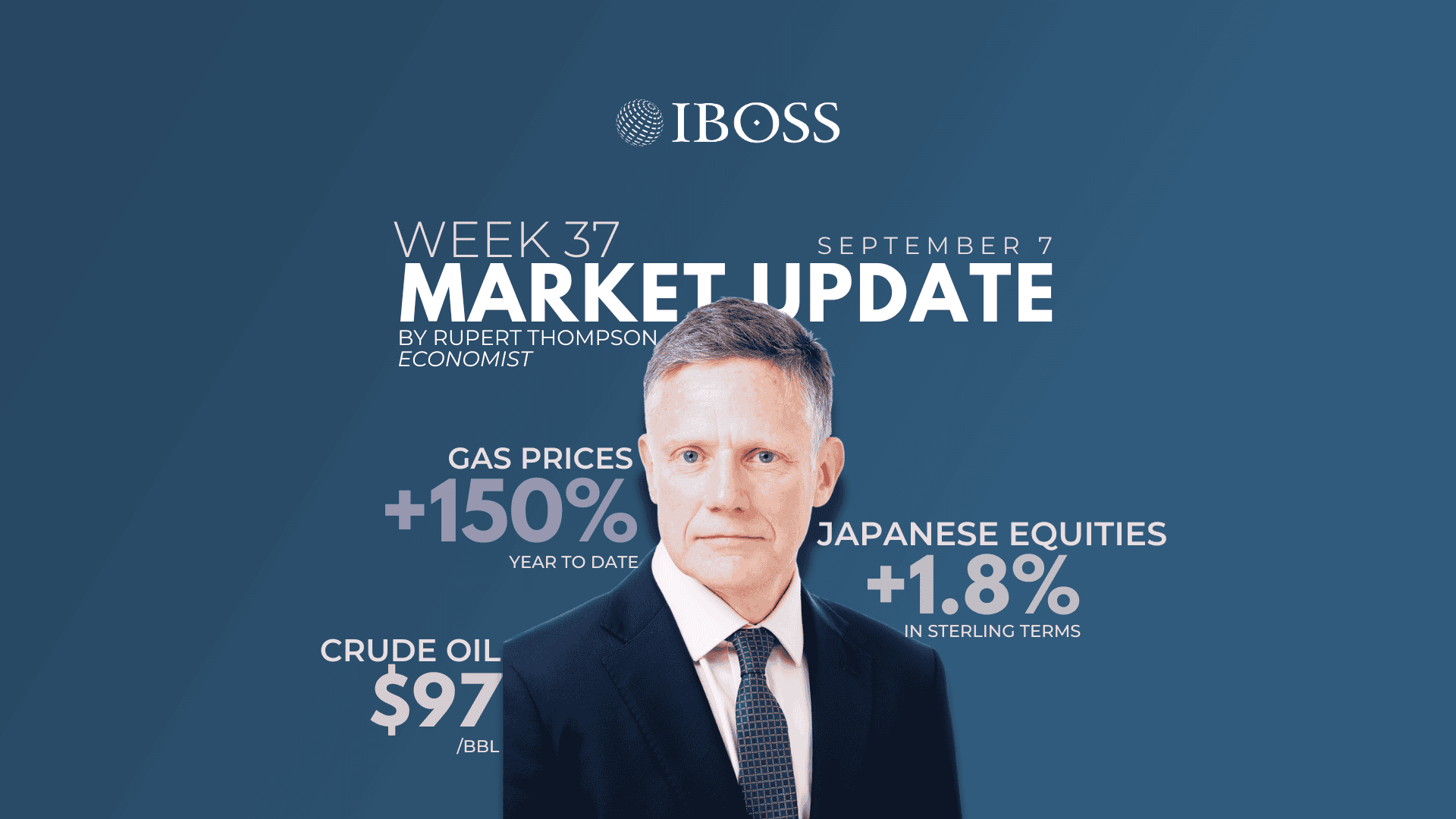
Last week was another quiet one for equity markets at least. Global equities edged down 0.1% in local currency and up 0.5% in sterling terms. Most markets saw modest gains although the UK was down fractionally and Japan was up 1.8%, buoyed by a strengthening of the yen on speculation of renewed intervention by the authorities.
Bond markets, by contrast, remained in the headlines with government bond yields hitting multi-year and in some cases multi-decade highs early on in the week. But yields subsequently fell back a little, ending the week up modestly in the US, flat in the UK and down slightly in Japan.
Meanwhile, oil prices resumed their upward climb with Brent crude rising to $97 per barrel as the stalemate continued with no sign that either the US or Iran are yet willing to back down. But it was European gas prices which were more in the news, hitting their highest level since the start of 2023 as nervousness grew over the relatively low storage levels ahead of winter.
Gas prices are up 150% since the start of the year although remain under half the levels seen during 2022. Still, this is unwelcome news for the UK and will add to upward pressure on inflation later in the year with UK electricity prices unnecessarily dependent on gas prices.
But it is bond yields which are the biggest source of angst. The 10-year UK gilt yield touched 5.28% last week, the highest level since 2008, before slipping back to 5.15%, and is up 0.6% since the start of the year.
This can only add to the pressure on the Chancellor to raise taxes in the October Budget – both to finance any increased spending commitments and restore the fiscal headroom. The latter has probably halved from the £24bn left by Rachel Reeves as a result of the rise in borrowing costs and other factors.
Much more important for markets generally, however, is the outlook for the 10-year US Treasury yield, which has also risen 0.6% this year to 4.8%. The key question is whether this upward march in yields will continue or whether most of the bad news is now priced in, which is much more our view.
Yields have been driven higher by three main factors – as we discussed in some detail two weeks ago: the credibility of Fed policy coming under threat; the dismal US fiscal position; and the increased competition for investor funds from the ton of debt now being issued to finance AI-related capital spending.
The second and third factors look set to remain in place but arguably the first factor is currently the most important. And Fed Chair Kevin Warsh has gone some way to restoring his credibility after a dismal start to his Chairmanship – restating in late August the Fed’s iron-clad commitment to its 2% inflation target.
A 0.25% hike at the Fed meeting on 17 September currently hangs in the balance. Chris Waller, a senior member of the Fed, stated last week that he favours keeping rates unchanged – just as the market had started to convince itself a hike was on the cards following Warsh’s August speech. So much for Warsh’s plan for reduced and less confusing forward guidance.
US payrolls on Friday then came in considerably stronger than expected, easing the fears of a softening in the labour market caused by the previous month’s unexpectedly weak numbers. This leaves inflation looking set to be the key to the Fed decision, with this coming Friday’s August numbers taking on added importance.
Either way, we are only looking at one or two US hikes at most over coming months and this is now priced into the market, so should not be a source of further upward pressure on yields. Crucially – despite all the headlines and the recent misjudged intervention by US Treasury Secretary Bessent – there has been no disorderly jump higher in yields or sign of panic. 10-year US yields are merely back towards the top end of their trading range since 2023 which saw yields reach a high of 5.0%.
The relatively orderly move higher in yields is one reason why we don’t believe it will de-rail equities. Equally important, despite no early end to the disruption in energy markets in sight, economies around the world have proven more resilient than expected and growth looks set to continue to hold up reasonably well.
Equity valuations have also already de-rated significantly, leaving them less vulnerable to higher bond yields. The global price-earnings ratio has fallen back to 16.8x. This remains 5-10% above the long-term average but is down significantly from a high of 19-20x seen in the second half of last year.
Finally, equities usually respond to the start of Fed tightening with a pause or small decline for a few months, only then to resume their earnings driven upward trend – as long as the rate hikes don’t cause a recession, which currently looks unlikely.
This coming week, US inflation data on Friday will be the main centre of attention. The ECB meeting will also be a focus with a 0.25% rate hike looking very much on the cards. Finally, there are UK GDP numbers for July out on Friday.
This communication is designed for professional financial advisers only and is not approved for direct marketing with individual clients. These investments are not suitable for everyone, and you should obtain expert advice from a professional financial adviser. Investments are intended to be held over a medium to long term timescale, taking into account the minimum period of time designated by the risk rating of the particular fund or portfolio, although this does not provide any guarantee that your objectives will be met. Please note that the content is based on the author’s opinion and is not intended as investment advice. It remains the responsibility of the financial adviser to verify the accuracy of the information and assess whether the OEIC fund or discretionary fund management model portfolio is suitable and appropriate for their customer.
Past performance is not a reliable indicator of future performance. The value of investments and the income derived from them can fall as well as rise, and investors may get back less than they invested.
IBOSS Asset Management Limited is authorised and regulated by the Financial Conduct Authority. Financial Services Register Number 697866.
IBOSS Asset Management Limited is owned by Mattioli Woods Limited is registered in England and Wales at Companies House, Registered number 3140521.
Registered Office is: 2 Sceptre House, Hornbeam Square North, Harrogate, HG2 8PB. Registered in England No: 6427223.
IAM 259.9.26