
Market Outlook
Markets continue to navigate an environment characterised by slower, but despite what many media outlets seem to focus on, still positive economic growth. In many places we have moderating inflation, elevated interest rates and heightened geopolitical uncertainty. While corporate earnings and consumer spending have generally remained supportive, investors face a backdrop in which government fiscal policy (spending what you don’t have), sovereign debt concerns, ongoing wars and AI related disruptions are all buffeting markets.
Although some of the major economic concerns that dominated markets over the past two years have eased, investors continue to face a wide range of potential risks. The combination of higher borrowing costs, elevated government debt levels and an uncertain geopolitical environment mean market volatility is likely to remain a feature of the investment landscape. Against this backdrop, diversification remains as important as ever.
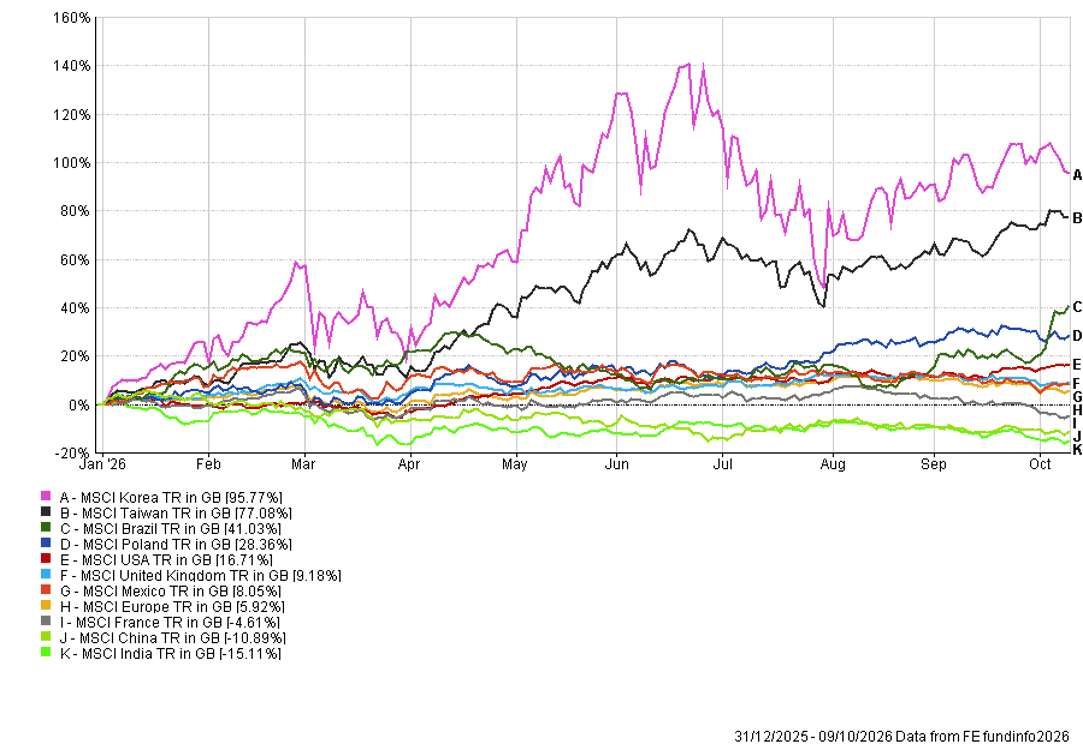
2026 continues to be a very unpredictable market. Two of the biggest economies in China and India are both having another poor year. The standout performers remain Korea and Taiwan, but both Poland and latterly Brazil have made very strong showings for very different reasons.
Selected Country 2026 Performance
Economic Growth
Global economic growth remains positive, albeit below long-term trend levels. The US continues to demonstrate resilience, supported by relatively robust consumer spending, healthy labour market conditions and ongoing investment in technology and infrastructure. Despite repeated predictions of recession over recent years and due in large part to fiscal largess of things such as the ironically named one big, beautiful bill’ , the US economy has continued to outperform expectations. The covid handouts and tax giveaways of recent years are now in the rearview mirror. The question now is, can the US continue to perform as strongly in the next few years?
As usual, Europe presents a more mixed picture. Economic activity remains subdued across several major economies, with manufacturing weakness, political uncertainty including the rise of what many consider to be far right parties and structural challenges weighing on business confidence. Germany continues to face economic headwinds, while broader concerns regarding competitiveness, demographics and industrial output have limited growth prospects across parts of the region.
The United Kingdom continues to experience modest growth, although higher borrowing costs and weak productivity trends remain constraints on economic expansion. The gilt market in particular is on high alert as we nervously approach another budget but we also have to factor in Burnham might call an early election.
Elsewhere, Asia and selected emerging markets remain important contributors to global growth. Domestic consumption, urbanisation, infrastructure investment and technology adoption continue to support activity, although export-oriented economies remain sensitive to slowing global demand and geopolitical tensions.
While recession concerns have diminished, economic growth remains vulnerable to policy mistakes, geopolitical shocks and any resurgence in inflationary pressures.
Inflation and Central Banks
Inflation has fallen significantly from the peaks experienced following the pandemic and energy crisis. However, the final stage of returning inflation sustainably to central bank targets continues to prove more challenging than many policymakers had hoped.
Services inflation remains relatively sticky, wage growth is still elevated in several economies, and energy prices retain the potential to become a renewed source of inflationary pressure. As a result, central banks have remained cautious when considering the appropriate pace of monetary easing.
Financial markets entered the year expecting a more accommodative environment, but policymakers have generally preferred patience over haste. While interest rates may gradually move lower over time, investors are increasingly accepting that the ultra-low interest rate environment that characterised much of the period between 2009 and 2021 is unlikely to return anytime soon.
For investors, this reinforces the importance of portfolio construction in a world where the cost of capital remains materially higher than many became accustomed to during the previous decade.
Fiscal Policy, Bond Markets and Sovereign Debt
One of the most important developments in recent months has been growing investor focus on government borrowing and fiscal sustainability.
Across many developed economies, debt levels remain historically elevated while budget deficits continue to expand. At the same time, governments must refinance debt at interest rates significantly higher than those available during the era of ultra-loose monetary policy.
These concerns have contributed to periods of weakness across global sovereign bond markets. In particular, developments in France have highlighted investor sensitivity towards fiscal policy and government finances. Wider concerns regarding public spending, debt sustainability and political uncertainty have contributed to higher borrowing costs and increased volatility within bond markets more broadly.
These developments reinforce a theme we have highlighted previously. Governments may not always impose fiscal discipline upon themselves, but bond markets can often act as the ultimate enforcer. US Secretary Scott Bessant recently stated “I have asymmetric information. I am the house now. Bet against me if you want.” Unfortunately for him he is mistaken and markets will do what they want based on all available information. As with Trumps comments on multiple issues, the more you jawbone but cannot back it up the quicker you degrade your personal currency.
Importantly, recent bond market volatility also serves as a useful reminder that diversification should not rely solely on historical assumptions. Bonds continue to play an important role in portfolios, but investors should recognise that different market environments can produce different outcomes from those experienced over previous decades and again we would highlight the use of emerging market debt as both a diversifier and potential source of additional alpha.
Geopolitics Remains Centre Stage
The war in Ukraine remains a significant source of uncertainty and continues to influence European defence spending priorities, fiscal planning and energy policy.
At the same time, tensions across the Middle East remain an important geopolitical risk. Any escalation involving major energy-producing nations or critical supply routes has the potential to increase oil price volatility, reignite inflationary pressures and weigh on investor sentiment.
Competition between major global powers also continues to reshape supply chains, trade relationships and investment decisions. Strategic rivalry between the United States and China remains one of the defining geopolitical themes influencing global markets.
Geopolitical risk can no longer be viewed as a temporary concern. Increasingly, it represents a structural feature of the investment environment that investors must be prepared to navigate.
Politics and Financial Markets
Political developments continue to exert a growing influence on financial markets.
Across much of the developed world, governments face difficult choices as they attempt to balance economic growth, rising public expectations and increasingly stretched public finances. Nevertheless, there appears to be limited political appetite for significant fiscal restraint. Jean?Claude Juncker once remarked that politicians know what to do, but not how to get re-elected after doing it. Recent developments in global bond markets suggest investors may be losing patience with governments that continue to choose popularity over fiscal discipline
In the United States, fiscal deficits, government borrowing and industrial policy remain key issues for investors to monitor. Political decisions are increasingly creating sector winners and losers, further emphasising the importance of maintaining diversified exposure across markets. With US midterms just weeks away Trump has his worst worse showing in the opinion polls for either of his stints as President. Even amongst Republicans his approval rating continues to deteriorate.
Energy Markets
Energy markets remain highly sensitive to geopolitical developments and supply disruptions.
While prices remain well below the extremes experienced in recent years, the combination of ongoing geopolitical tensions, underinvestment in some traditional energy infrastructure and growing global demand means supply risks have not disappeared.
Energy remains a critical input for the global economy. Sustained increases in oil or gas prices would have implications for inflation, economic growth and monetary policy, making energy markets an important factor in the outlook for investors.
Artificial Intelligence: Opportunity and Risk
Artificial intelligence remains one of the most significant structural investment opportunities in global markets. Investment in semiconductors, data centres, cloud infrastructure and software development continues at a rapid pace, with the potential to deliver meaningful productivity gains across multiple industries.
However, investor enthusiasm has also contributed to increasingly concentrated market leadership. A relatively small number of technology companies have accounted for a significant proportion of global equity returns in recent years.
While the long-term opportunity remains compelling, periods of technological innovation are rarely smooth. Regulatory intervention, valuation concerns, competitive pressures and shifts in investor sentiment may all create periods of volatility.
The Importance of Diversification
Perhaps the clearest lesson from recent market developments is the enduring value of diversification.
Over the past year, investors have experienced periods where a handful of technology companies dominated returns, episodes of weakness across sovereign bond markets and sudden shifts in sentiment driven by geopolitical developments. More recently, the French and broader global bond market sell-off demonstrated that risks can emerge from areas many investors may not be closely watching.
Successfully predicting every economic, political or market outcome is virtually impossible. Diversification acknowledges this reality. By maintaining exposure across different regions, sectors, asset classes and investment styles, investors reduce reliance on a single outcome or investment theme.
While concentrated positions can deliver strong returns during favourable periods, they can also leave investors exposed when market leadership changes. A diversified portfolio is designed not to maximise returns under one scenario, but to remain resilient across a range of potential outcomes.
In our view, the coming years are likely to remain characterised by geopolitical uncertainty, evolving monetary policy, fiscal challenges and rapid technological change. Against such a backdrop, diversification may help reduce concentration risk, although it does not eliminate investment risk or guarantee positive returns.
There can be no guarantee these expectations will be realised.
IBOSS Performance Update
Following a positive August, the IBOSS portfolios had a more challenging September. Whilst many lower-risk portfolios outperformed their benchmarks over the month, the higher-risk portfolios saw some relative underperformance as allocations to the UK, Europe and large parts of emerging markets lagged the global average.
These areas have been particularly positive for the portfolios over the last few years, as investors have been rewarded for looking beyond the largest global companies. September saw some of that trend reverse, with US assets proving more resilience largely due to a stronger dollar. European equities, for example, fell 2.8% over the month compared with a positive return of 1.66% in the US, and a whopping 3.57% for Japanese equities.
1 Year Regional Return
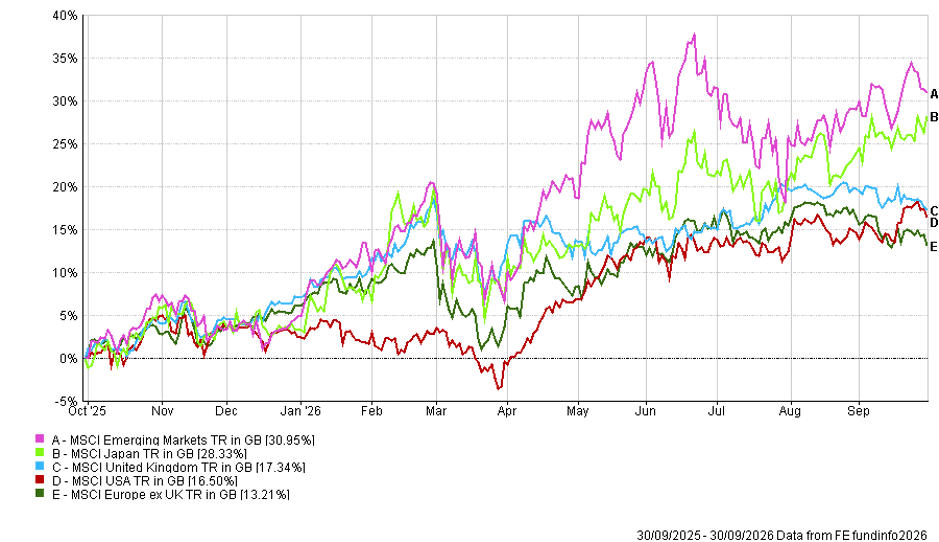
Whilst September was a useful reminder that trends do not last forever, the month’s returns do little to change our view on the opportunities from here. The IBOSS portfolios maintain a meaningful position in US assets, however we are overweight other areas of the equity complex, including UK equities, Europe, Asia, Emerging Markets and Japanese equities.
We feel this broader approach is increasingly important in an environment characterised by geopolitical uncertainty and wider dispersion of returns. Whilst this can create volatility, it can also create opportunities for portfolios positioned to capture them.
As mentioned previously, the IBOSS lower-risk portfolios performed well during what has been a more difficult period for fixed income assets.
Bond yields moved sharply higher during September, with the US 10-year Treasury yield ending the month above 5% as markets reassessed the outlook for inflation and interest rates. The move has been painful for parts of the bond market in the short term, but it has also further improved the level of income available to investors. That is something we have been discussing for some time and one we are looking to take advantage of in the portfolio changes being made this quarter. To put this into context at the time of writing, US Treasury yields have risen on 18 of the last 25 trading days, something which has occurred only 11 times since the 1960s.
Higher yields do not automatically mean an easier environment for bond investors. September demonstrated how quickly expectations can change, particularly around inflation and interest rates. Our focus remains on finding managers capable of benefiting from today’s higher yields without relying on a single interest-rate outcome.
(For more information on our view on fixed income markets: The Rise of the Bond – IBOSS)
A Note On Risk
With geopolitical uncertainty remaining elevated, it is understandable that some clients may feel uncomfortable or be tempted to make changes to their investments. However, periods of uncertainty are an inevitable part of investing and patient investors have historically been rewarded for remaining invested through them.
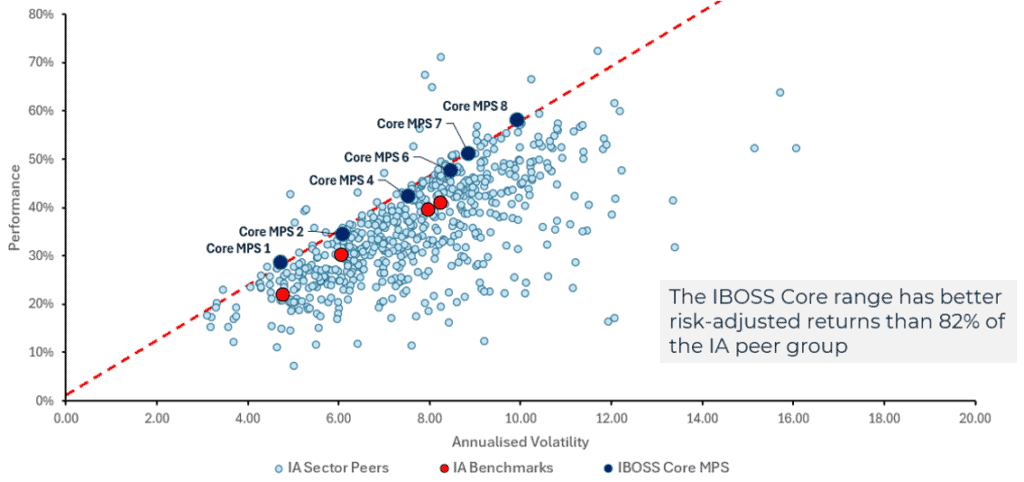
For clients to stay invested through difficult periods, they need to be comfortable with the level of risk they are taking in the first place. Ultimately, investors experience two things: the return they receive, and the risk taken to achieve it. Both matter, and managing the balance between the two has always been an intrinsic part of the IBOSS approach.
The charts below show the risk and return of the IBOSS portfolios against their respective peer groups, both since launch in 2008 and over the last three years. Whilst there are portfolios that have delivered higher returns, and others that have taken less risk, relatively few have achieved the combination of higher returns and lower risk.
For a more in-depth performance information for all IBOSS MPS ranges & OEICs please visit our website: Portfolio & Fund Performance – IBOSS
IBOSS CORE: Start of Data risk & return (01/11/2008 – 30/09/2026)
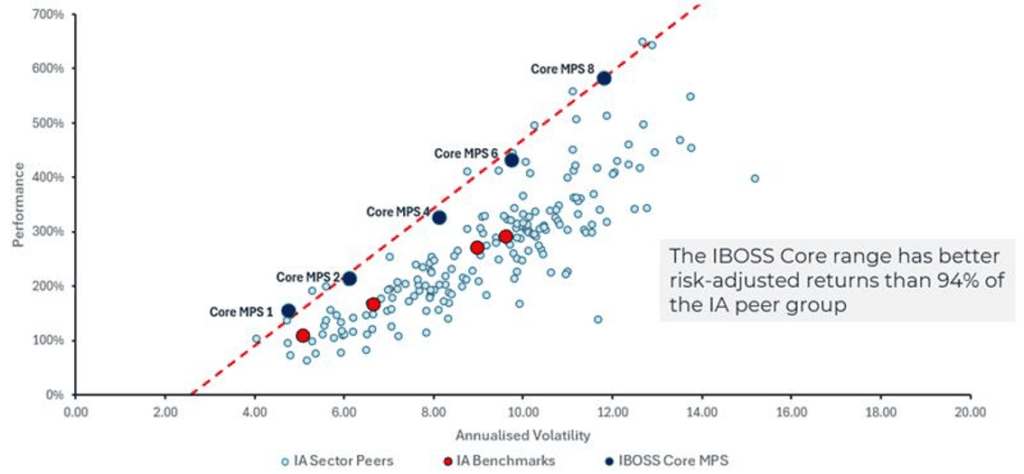
3 Year risk & return (30/09/2023 – 30/09/2026)
The data presented covers a limited time period due to the context of this metric. Short-term performance may not be indicative of long-term trends. Investors should consider longer-term performance data and other relevant factors before making investment decisions.
This communication is designed for professional financial advisers only and is not approved for direct marketing with individual clients. These investments are not suitable for everyone, and you should obtain expert advice from a professional financial adviser. Investments are intended to be held over a medium to long term timescale, taking into account the minimum period of time designated by the risk rating of the particular fund or portfolio, although this does not provide any guarantee that your objectives will be met. Please note that the content is based on the author’s opinion and is not intended as investment advice. It remains the responsibility of the financial adviser to verify the accuracy of the information and assess whether the OEIC fund or discretionary fund management model portfolio is suitable and appropriate for their customer.
Past performance is not a reliable indicator of future performance. The value of investments and the income derived from them can fall as well as rise, and investors may get back less than they invested.
IBOSS Asset Management Limited is authorised and regulated by the Financial Conduct Authority. Financial Services Register Number 697866.
IBOSS Asset Management Limited is owned by Mattioli Woods Limited is registered in England and Wales at Companies House, Registered number 3140521.
Registered Office is: 2 Sceptre House, Hornbeam Square North, Harrogate, HG2 8PB. Registered in England No: 6427223.