
Whatever happened to the bond fund?
Back when I started in the investment industry more than 15 years ago, as a fresh-faced and enthusiastic gent in my early 20s, fixed income was booming and home to some of the most recognisable fund names in the industry.
Funds such as Fidelity Moneybuilder, Jupiter Strategic Bond, M&G Optimal Income, L&G Dynamic Bond and Templeton were household names, as bond funds benefited from falling yields while equities were still dealing with the fallout from the technology boom and subsequent bust.
In the years that followed, falling interest rates made the fixed income opportunity progressively less attractive. Yields were pushed towards zero, and in some cases even lower, leaving investors with increasingly little compensation for taking duration risk.
Fast forward to today and fixed income investors have had a torrid time. The Bloomberg Global Aggregate has returned 33%, against 597% for the MSCI World Index over 15 years, while investor flows and interest in fixed income funds have waned.
As we reported earlier this year, the most popular funds no longer include any fixed income funds. Instead, the list is dominated by equity index funds, reflecting both the strong performance of equities and the lack of appeal that fixed income offered investors for much of the last decade.
Bessent Is Talking. Is the Bond Market Listening?
Perhaps the best indication of just how far fixed income has fallen out of fashion is that many of today’s investors will have little recollection of a time when bond funds dominated the best-seller lists.
Yet, somewhat ironically, the bond market has rarely been more front and centre with the recent interventionist actions from the US and the still-fresh-and-very-much-part-of-the-investment-lexicon Liz Truss moment. So, whether you’re bothered about bonds or not, it may be time to start paying attention to the bond market.
One person that is certainly giving the bond market due consideration is Scott Bessent.
Considering US Treasury yields have risen in what has, for the most part, been a relatively orderly fashion, it is somewhat surprising to see just how aggressively Bessent has come out of the gate.
The US Treasury has increased its focus on buying back longer-dated Treasuries, with Bessent suggesting that the size of these operations could increase further. He has also been unusually vocal about the importance of keeping Treasury yields under control, while the US has separately become involved in supporting the Japanese yen.
The reaction to both interventions has been particularly interesting as both the Yen and the US 10-year yield initially moved as expected but then quickly proceeded to give back a significant proportion of those gains.
It is a little like having a couple of beers with a friend on a Saturday night, joking that perhaps they are getting a bit carried away, only for them to launch into an unusually passionate defence of their drinking habits. At some point, the strength of the response starts to become part of the story.
Bessent’s response to the bond and currency markets may be telling us something similar and perhaps there is more to worry about beneath the surface.
Emerging Markets love interventionist policies… and now Developed markets do too.
Many have pointed out that this type of interventionist approach would traditionally have been more associated with an emerging market economy than the world’s largest developed-market economy.
We have made the point for some time that the gap between emerging and developed markets has narrowed from a policy and political stability perspective. Not necessarily because emerging markets have suddenly become more stable, but because parts of the developed world have become considerably less predictable.
The Trump administration is perhaps the clearest example. From tariffs to fiscal policy to foreign exchange, the policy approach has at times resembled a game of whack-a-mole, with markets reacting to whichever issue has moved to the top of the agenda that week.
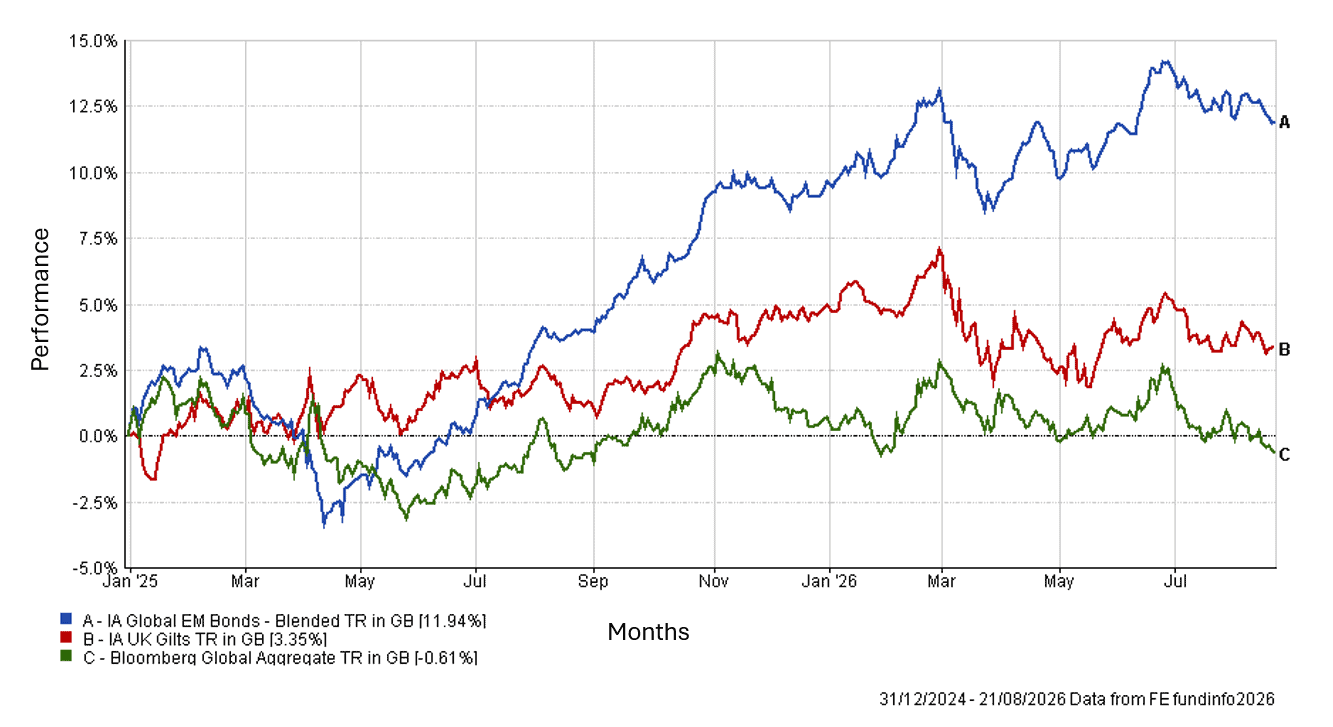
We believe EMD may continue to offer diversification benefits, although there is no guarantee this will occur for portfolios. More importantly, it is a useful reminder that while the headlines will undoubtedly continue to focus on the US and the problems facing developed-market sovereign debt, there may be opportunities elsewhere.
The chart below shows the performance of the EMD blended funds with gilts and the global avg since the start of 2025, which captures the influence of Trump’s second term.
Emerging Market Debt Performance to 21/08/2026
Source: FE FundInfo
The Same old Corporate Credit Jitters
One other area that has seen an increasing amount of attention is corporate debt. Investors have been concerned about valuations here for an absolute age and, whilst spreads are incredibly tight, returns have been very positive for investors.
That said, rumblings of issues keep arising. Whether it is the (now seemingly forgotten) liquidity concerns facing private credit or the ballooning debt of the Magnificent Seven hyperscalers, which now, excluding Apple, have circa $800bn of debt on their balance sheets and an estimated $1.6tn off balance sheet, there are plenty of reasons to at least ask whether investors are being adequately compensated for the risks they are taking.
The AI boom is perhaps the most obvious example. The amount of money being committed to data centres and AI infrastructure is enormous and, whilst the equity market has been focused on who will win the AI race, less attention has been paid to who is ultimately financing it.
That financing is increasingly finding its way into debt markets, private credit and various off-balance-sheet structures.
We aren’t suggesting that this is necessarily the next credit crisis. But when spreads are tight, you don’t need a full-blown crisis for things to become uncomfortable. If the economic outlook deteriorates, defaults rise or investors simply decide that they want a little more compensation for taking credit risk, spreads can move quickly.
This is where the headline yield can become slightly misleading. A corporate bond offering 5% or 6% might look attractive compared with the zero-rate world we became accustomed to, but if the additional yield over government bonds is historically small, investors need to ask what they are actually being paid for taking the extra risk.
That, in our view, is where being selective becomes increasingly important. Much of our corporate bond exposure is therefore tied up with strategic bond managers who have the flexibility to move across different parts of the bond market rather than being tied solely to credit.
Everybody hates Bonds
So, we’ve talked about how bond funds have become increasingly unpopular and how, across the bond market, there are plenty of issues to consider and think about. On the face of it, this blog post perhaps makes for the least compelling case for fixed income assets ever.
And yet, perhaps that is exactly what makes it interesting…
The concerns facing fixed income assets are widely known and were felt most acutely by low-risk investors as interest rates rose and then again during the Liz Truss budget. In our view, many of these concerns may already be reflected in market prices, and we have seen a growing number of managers looking at fixed income assets with renewed interest.
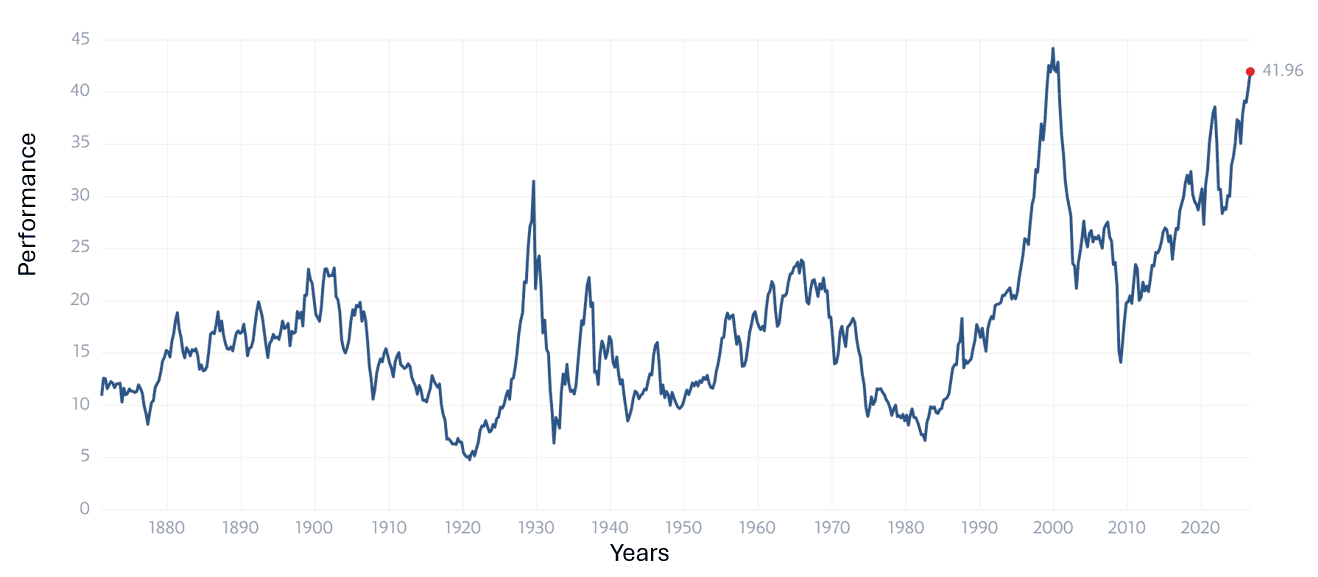
On the flip side, in equity land, the degree and breadth of concerns is equally wide and shares a significant amount of crossover with the points we have already discussed. However, equities remain expensive, with the CAPE ratio (Cyclically Adjusted Price-to-Earnings ratio) (source: multpl.com) sitting at around 42x, a level only exceeded by the dot-com bubble.
That was a period when equities subsequently underperformed fixed income for close to 20 years.
Shiller PE to August 2021
Source: multpl.com
Fixed Income vs Equities – 31/12/1999 to 31/12/2020
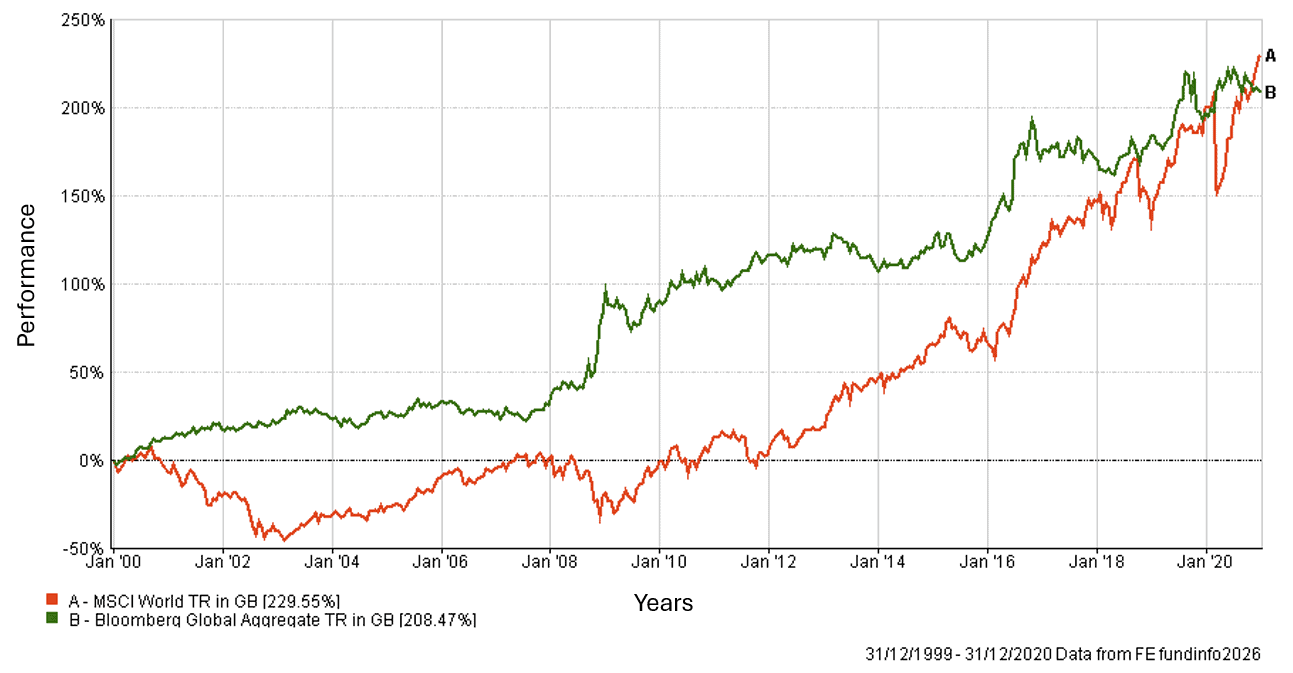
We still like equities. But with bond yields now considerably more attractive than they have been for much of the last 15 years, very little investor attention on the asset class and plenty of volatility for active managers to exploit, we think fixed income deserves a meaningful place in portfolios.
We have increasingly used strategic bond managers alongside sovereign exposure, giving managers the flexibility to move across duration, credit and different bond markets. This diversified approach has served our lower-risk portfolios well and provided another source of returns during what has been a difficult period for traditional bond investors.
Perhaps the biggest difference between now and the last decade is that investors don’t need to rely on falling interest rates to make money from bonds. The yield is already there. If rates remain around current levels, investors can earn a reasonable return simply from holding the asset, with active managers able to add to that through duration, credit and relative-value decisions.
And if equities do have a more difficult period, bonds don’t need to be perfectly uncorrelated to be useful. They just need to do something different.
After years of being ignored, perhaps it is time to start paying attention to bonds again. And who knows, maybe we’ll see the rise of a new generation of fixed income star managers.
The data presented covers a limited time period due to the context of this metric. Short-term performance may not be indicative of long-term trends. Investors should consider longer-term performance data and other relevant factors before making investment decisions.
This communication is designed for professional financial advisers only and is not approved for direct marketing with individual clients. These investments are not suitable for everyone, and you should obtain expert advice from a professional financial adviser. Investments are intended to be held over a medium to long term timescale, taking into account the minimum period of time designated by the risk rating of the particular fund or portfolio, although this does not provide any guarantee that your objectives will be met. Please note that the content is based on the author’s opinion and is not intended as investment advice. It remains the responsibility of the financial adviser to verify the accuracy of the information and assess whether the OEIC fund or discretionary fund management model portfolio is suitable and appropriate for their customer.
Past performance is not a reliable indicator of future performance. The value of investments and the income derived from them can fall as well as rise, and investors may get back less than they invested.
IBOSS Asset Management Limited is authorised and regulated by the Financial Conduct Authority. Financial Services Register Number 697866.
IBOSS Asset Management Limited is owned by Mattioli Woods Limited is registered in England and Wales at Companies House, Registered number 3140521.
Registered Office is: 2 Sceptre House, Hornbeam Square North, Harrogate, HG2 8PB. Registered in England No: 6427223.
IAM 246.8.26