
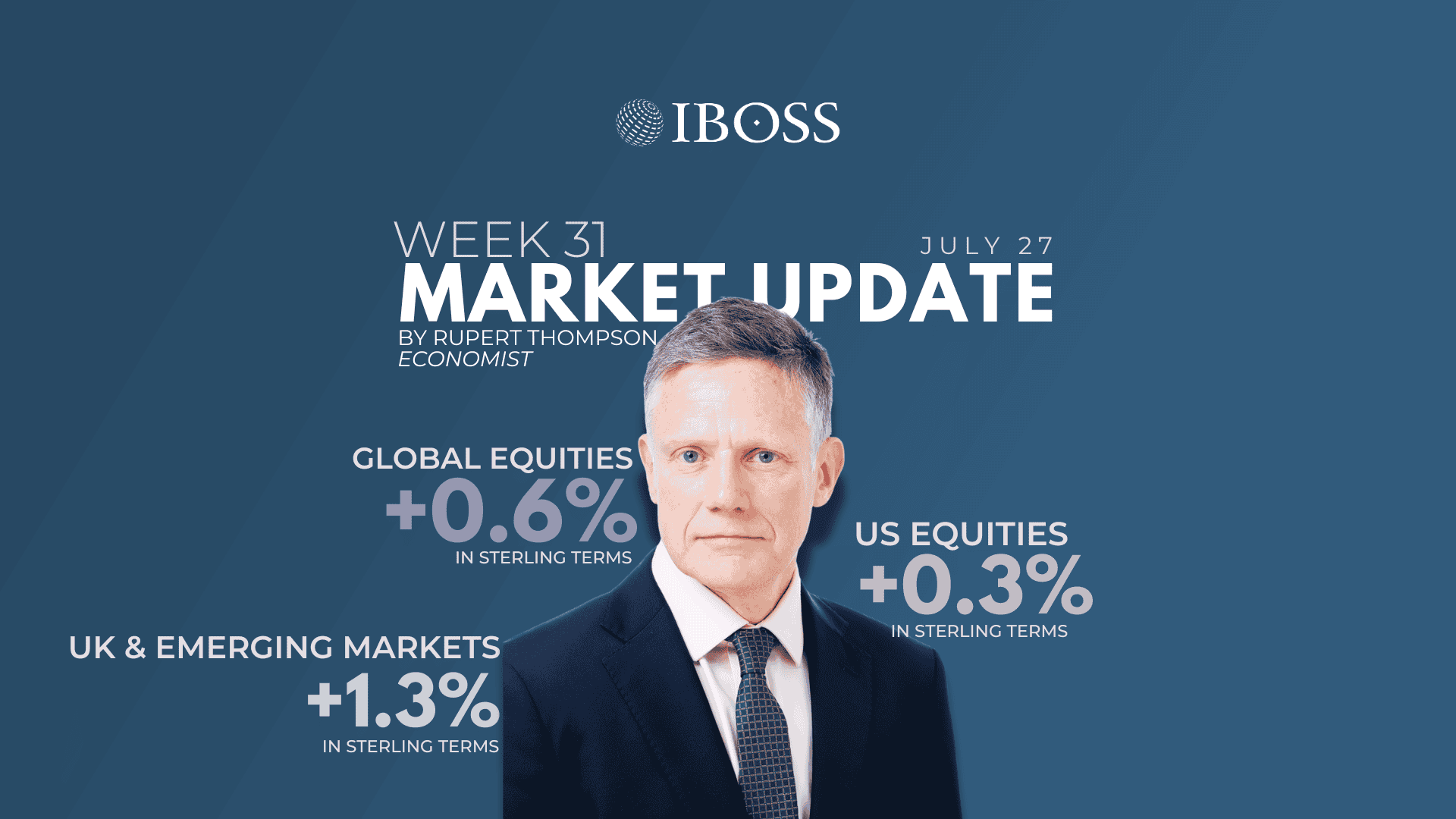
Global equities ended last week little changed in local currency and up 0.6% in sterling terms. This continued the choppy pattern of recent weeks with markets currently down 1.5-2% from their peak in early June. The US underperformed with a gain of 0.3% in sterling terms while the UK and emerging markets were both up around 1.3%.
Meanwhile, government bonds in the US and UK both lost 0.5% with yields re-testing their highs in early May. 10-year UK gilt yields tested 5.1% while US yields reached 4.7%, before retreating a bit.
The war with Iran was centre stage with renewed attacks by both sides and Trump once again upping his threats. The new ingredient this time was that concerns were not limited to the Strait of Hormuz but extended to the Bab El-Mandeb Strait with the Houthis exchanging blows with Saudi Arabia and threatening to close the waterway.
The importance of this new chokepoint is two-fold. First, it threatens Saudi’s ability to divert via its pipeline a good part of its oil production to the Red Sea rather than the Strait of Hormuz. Second, it poses a threat to container traffic more generally which use the Suez Canal to avoid a long and costly diversion around the African coast.
Oil duly moved back up to $100 per barrel mid-week from a low of close to $70pb all of three weeks ago. But it is back down to $88pb this morning as negotiations between the US and Iran started up once again over the weekend, easing fears of a major escalation. However, this morning, Iran said it is not seeking new peace talks, so the confusion continues.
Even so, the fact remains that Trump appears to have chickened out yet again – be it because the hike in oil prices has pushed US gasoline prices back above $4 per gallon, the rise in US Treasury yields has caused concerns or because, as has been reported, the US lacks the necessary munitions.
Still, the resurgence of oil prices has reignited concerns that central bankers will be pushed into raising rates later this year. The European Central Bank left rates unchanged last week – having already raised them 0.25% in June – but left open the prospect of an increase in September.
The US Fed meets this coming Wednesday and, while it is also likely to leave rates unchanged, a hike also looks quite possible in September. As for the Bank of England on Thursday, no change looks almost certain to be the order of the day but once again a hike is possible later in the year. As elsewhere, this will very much depend on the situation in the two straits and whether oil by then is closer to $70pb or $100pb.
Recent UK news will if anything have eased the Bank’s inflation concerns. The headline inflation rate fell to 2.6% in June from 2.8% while the core rate was unchanged last month. Wage gains have also slowed further with private sector earnings growth easing to 2.9% in May.
On the growth front, the news has also been quite encouraging with some signs of the UK consumer cheering up. Sentiment bounced in July, recovering much of its drop earlier in the year, and retail sales posted an unexpectedly large gain in June.
UK business confidence also recovered in July – no doubt on misplaced hopes that tensions in the Middle East had eased – having dipped into recessionary territory the previous couple of months. Sentiment in the US and Eurozone also bounced this month.
But obviously all the attention in the UK has been on the intentions of the new incumbent of No 10. And Andy Burnham managed to pull off a big surprise with his first appointment, namely his choice of John Healey as Chancellor. Healey is generally perceived to be a safe pair of hands although in another feeling of déjà vu – as with the war with Iran – we are once again back to worrying about potential tax rises in the Autumn Budget.
The headroom to meet the fiscal rules put in place by Rachel Reeves has already shrunk from £24bn in March to only £10bn, leaving little room to fund Burnham’s policy initiatives. The 5% reduction in VAT on electricity bills, £2 cap on bus fares and cut in business rates for pubs already announced will cost only £1.5-2bn but other forthcoming initiatives may be considerably more costly.
Most obviously, there is the question of how to fund an increase in defence spending to 3% of GDP which Healey looks certain to push for, given he resigned over the issue in June. While there is very unlikely to be a wholesale re-writing of the fiscal rules, there may well be some tweaking which will keep gilt yields under some upward pressure over coming months.
In other news, the US imposed yet another set of tariffs on its trading partners. These replace the temporary 10% global tariff which had been instated following the previous tariffs being ruled unlawful. They range from 10-12.5% and the excuse this time rather bizarrely is the use of forced labour. They don’t amount to a big change but somewhat surprisingly the UK now comes off slightly worse than the EU, rather than slightly better as had been the case.
Last but far from least, the corporate earnings season is in full swing and has got off to a good start in the US. Earnings are beating estimates by more than usual and the S&P 500 is now on course to see profits grow as much as 38%, helped by the surge in earnings reported last week by Alphabet on the back of a revaluation of its stakes in Anthropic and SpaceX. Excluding Alphabet, S&P earnings growth is set to be a rather lower but still exemplary 25%.
But these days, markets are more focused on the enormous capex plans of the Magnificent Seven than their earnings. And with Alphabet revising up its plans even higher and running out of profits to finance them, the stock ended the week down 8%. Still, this was a better performance than Tesla which was down 18% following a slump in its earnings.
This coming week is a busy one. We have the Fed meeting on Wednesday and BOE meeting on Thursday. We also have second quarter growth numbers out for the US and EU on Thursday, as well as inflation data for both regions. Finally. Meta and Microsoft report on Wednesday and Amazon and Apple on Thursday.
This communication is designed for professional financial advisers only and is not approved for direct marketing with individual clients. These investments are not suitable for everyone, and you should obtain expert advice from a professional financial adviser. Investments are intended to be held over a medium to long term timescale, taking into account the minimum period of time designated by the risk rating of the particular fund or portfolio, although this does not provide any guarantee that your objectives will be met. Please note that the content is based on the author’s opinion and is not intended as investment advice. It remains the responsibility of the financial adviser to verify the accuracy of the information and assess whether the OEIC fund or discretionary fund management model portfolio is suitable and appropriate for their customer.
Past performance is not a reliable indicator of future performance. The value of investments and the income derived from them can fall as well as rise, and investors may get back less than they invested.
IBOSS Asset Management Limited is authorised and regulated by the Financial Conduct Authority. Financial Services Register Number 697866.
IBOSS Asset Management Limited is owned by Mattioli Woods Limited is registered in England and Wales at Companies House, Registered number 3140521.
Registered Office is: 2 Sceptre House, Hornbeam Square North, Harrogate, HG2 8PB. Registered in England No: 6427223.
IAM 236.8.26