
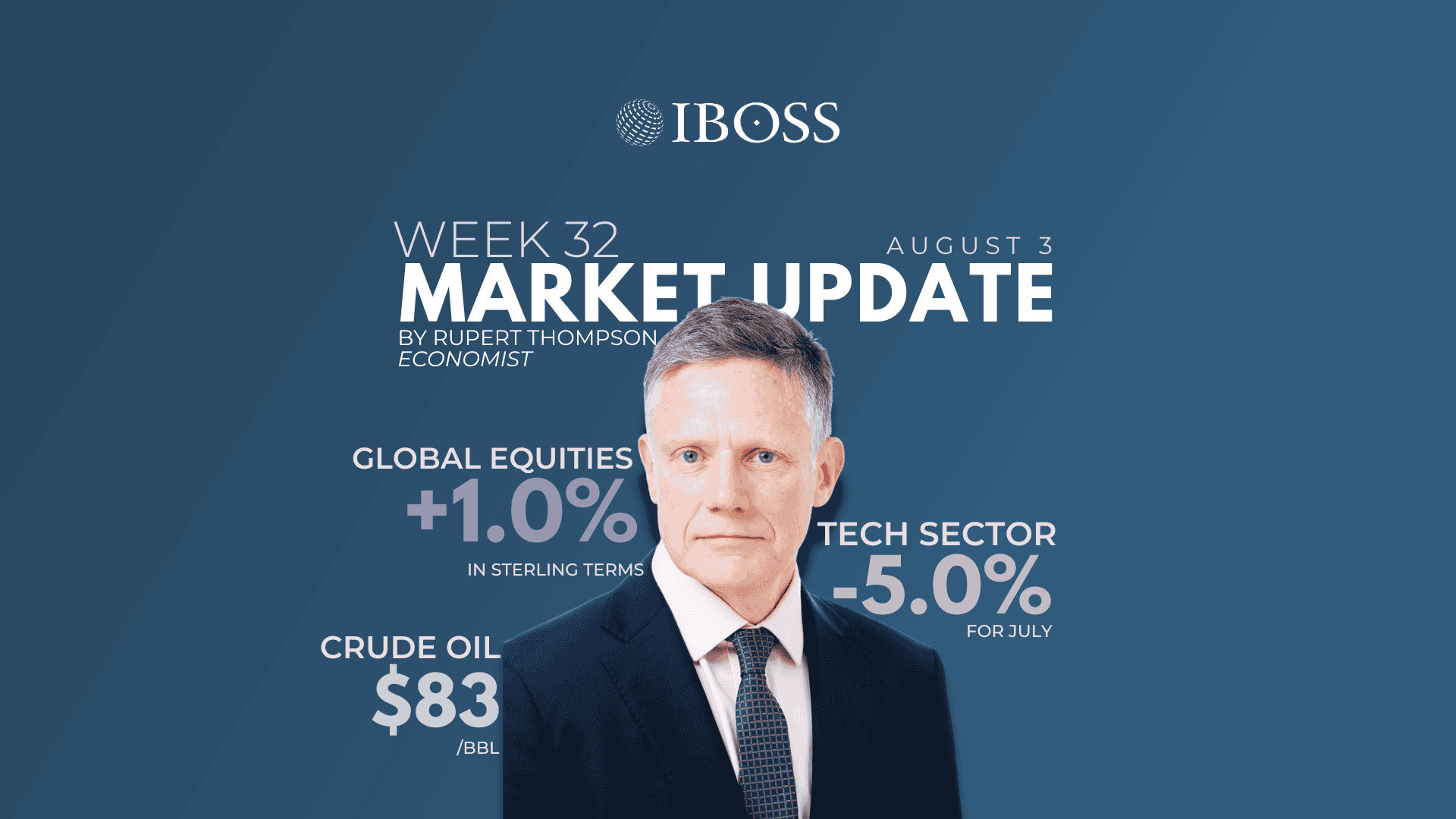
Global equities saw another week of heightened volatility with markets down 1% on Wednesday, only to recover their loss and more on Thursday and Friday. Markets ended the week up 0.4% in local currency and 1.0% in sterling terms.
US equities underperformed, mainly because of a fall in the dollar, and were unchanged over the week in sterling terms while other regions were generally up around 1% or so.
Elsewhere, government bonds ended last week little changed in both the US and UK and oil prices reversed much of their spike the previous week, falling back to $83 per barrel this morning
The heightened volatility of markets of late and the stalling of the equity rally are really down to three main factors.
First of course, there is the continuing uncertainty over the war in Iran. It remains far from clear how fast and to what the extent the Strait of Hormuz will be reopened. And there are also now the worries about the Bab El-Mandeb strait.
Last week saw more of the same with US and Iran exchanging further blows while negotiations continued in the background. And in another been here before moment, this weekend saw Trump back down from his latest threats to escalate the US attacks with peace talks supposedly resuming today. To add to the confusion, Oman and Iran are now apparently close to agreeing a route through the Strait of Hormuz acceptable to both sides.
Trump’s Board of Peace also announced an agreement for the complete disarmament of Hamas. But as with most of his so-called peace deals, this is far from a done deal with the disarmament predicated on a host of conditions which Israel looks unlikely to accept.
Second and equally important, the tech sector has seen increasingly large swings in sentiment and prices. It has underperformed by 5% over the last month with semiconductor chip companies falling as much as 20% after their surge earlier in the year.
Indeed, while the tech sector overall last week performed broadly in line with the market, chip companies saw wild fluctuations with the chip-dominated Korean index down as much as 17% mid-week before bouncing sharply on Friday.
The volatility has not been confined to the chip sector with the Magnificent Seven also seeing large price swings. Following their results, Microsoft and Amazon surged 22% and 17% respectively last week while Apple and Meta (Facebook) were both down 7%.
Even the so-called Nostradamus of AI, a 24-year old whizz kid behind a $20bn hedge fund investing in tech stocks, has been caught out by recent events. After spectacular gains earlier in the year, sharp losses along with leveraged financing, have prompted a forced sale of the fund’s holdings.
All this reflects the market’s growing nervousness over the massive AI-related capex of the so-called hyperscalers – Alphabet, Amazon and Microsoft being the three largest. Concerns over whether these outlays will prove sufficiently profitable have been heightened by recent news that the latest Chinese AI models are nearly as good as those of Anthropic and OpenAI, yet are a fraction of the cost.
Another worry is that the hyperscalers are running out of internal funds to finance all this expenditure and are increasingly issuing equity and bonds to finance it. Lastly, there remains the unanswered trillion-dollar question of the extent to which AI will be adopted across the broader economy, with some companies now purportedly cutting back their usage because of its growing cost.
Interest rates are the final source of recent market jitters. The US Fed left rates unchanged last week as expected but market qualms over the direction of its policy increased.
Fed Chair Kevin Warsh believes in giving as little future guidance as possible and this backfired with his few comments succeeding only in spreading confusion. The market ended up a bit less confident than before that rates will be raised later this year despite three members of the Fed voting for a hike at last week’s meeting.
The problem here is that the latest US GDP and inflation numbers seem to argue for higher rates. The headline growth rate slowed to a quarterly annualised 1.5% in the second quarter but underlying growth actually picked up to a 3-4% pace. Meanwhile, the Fed’s favoured inflation measure showed the headline and core rates of inflation running at 3.7% and 3.3% in June, well above its 2% target.
Anyway, the net result was that increased worries over how exactly the Fed intends to return inflation to 2% led to a rise in 30-year Treasury yields to 5.25%, their highest level in nearly 30 years.
Here in the UK, the Bank of England also left rates unchanged. Three members of the nine-strong MPC voted for a hike but guidance from Governor Bailey led to expectations of a rate hike being pushed back from September to November. Bailey said there was little evidence as yet that the global energy crisis had stoked broader price pressures while noting the possible need for higher rates if it continued for much longer.
It is now confirmed that John Healey’s first Budget will be on 28 October. The challenge over the next three months will be to avoid the damage done to business confidence in the run-up to the last two budgets as a result of endless speculation over forthcoming tax rises.
There was also a Bank of Japan meeting last week but this left rates unchanged and was not the main source of attention. Instead, it was news that the US and Japan had jointly intervened for the first time since 2011 to support the yen which has been testing new lows in recent weeks.
The yen has now recovered to 158Y/$ from a low of 163Y/$. But it remains to be seen whether this recovery will be sustained without the Bank of Japan speeding up the pace of monetary tightening which has been glacial so far.
The last bit of noteworthy news was that Eurozone GDP came in stronger than expected in the second quarter. Recent numbers have been distorted by Ireland of all places but the underlying picture – as elsewhere – is that growth continues to hold up reasonably well despite Trump’s best efforts.
None of the three areas of market uncertainty outlined above looks likely to disappear in a hurry and global equities could well continue to tread water for a while yet, before further gains in corporate earnings allow them to resume their upward trend. It also means the sharp rotation between different sectors and stocks seen lately may continue, emphasising the importance of remaining well diversified and avoiding over-exposure to whatever is the latest hot fad.
This coming week, the main focus on the macro side will be the US payroll numbers on Friday.
This communication is designed for professional financial advisers only and is not approved for direct marketing with individual clients. These investments are not suitable for everyone, and you should obtain expert advice from a professional financial adviser. Investments are intended to be held over a medium to long term timescale, taking into account the minimum period of time designated by the risk rating of the particular fund or portfolio, although this does not provide any guarantee that your objectives will be met. Please note that the content is based on the author’s opinion and is not intended as investment advice. It remains the responsibility of the financial adviser to verify the accuracy of the information and assess whether the OEIC fund or discretionary fund management model portfolio is suitable and appropriate for their customer.
Past performance is not a reliable indicator of future performance. The value of investments and the income derived from them can fall as well as rise, and investors may get back less than they invested.
IBOSS Asset Management Limited is authorised and regulated by the Financial Conduct Authority. Financial Services Register Number 697866.
IBOSS Asset Management Limited is owned by Mattioli Woods Limited is registered in England and Wales at Companies House, Registered number 3140521.
Registered Office is: 2 Sceptre House, Hornbeam Square North, Harrogate, HG2 8PB. Registered in England No: 6427223.
IAM 238.8.26