
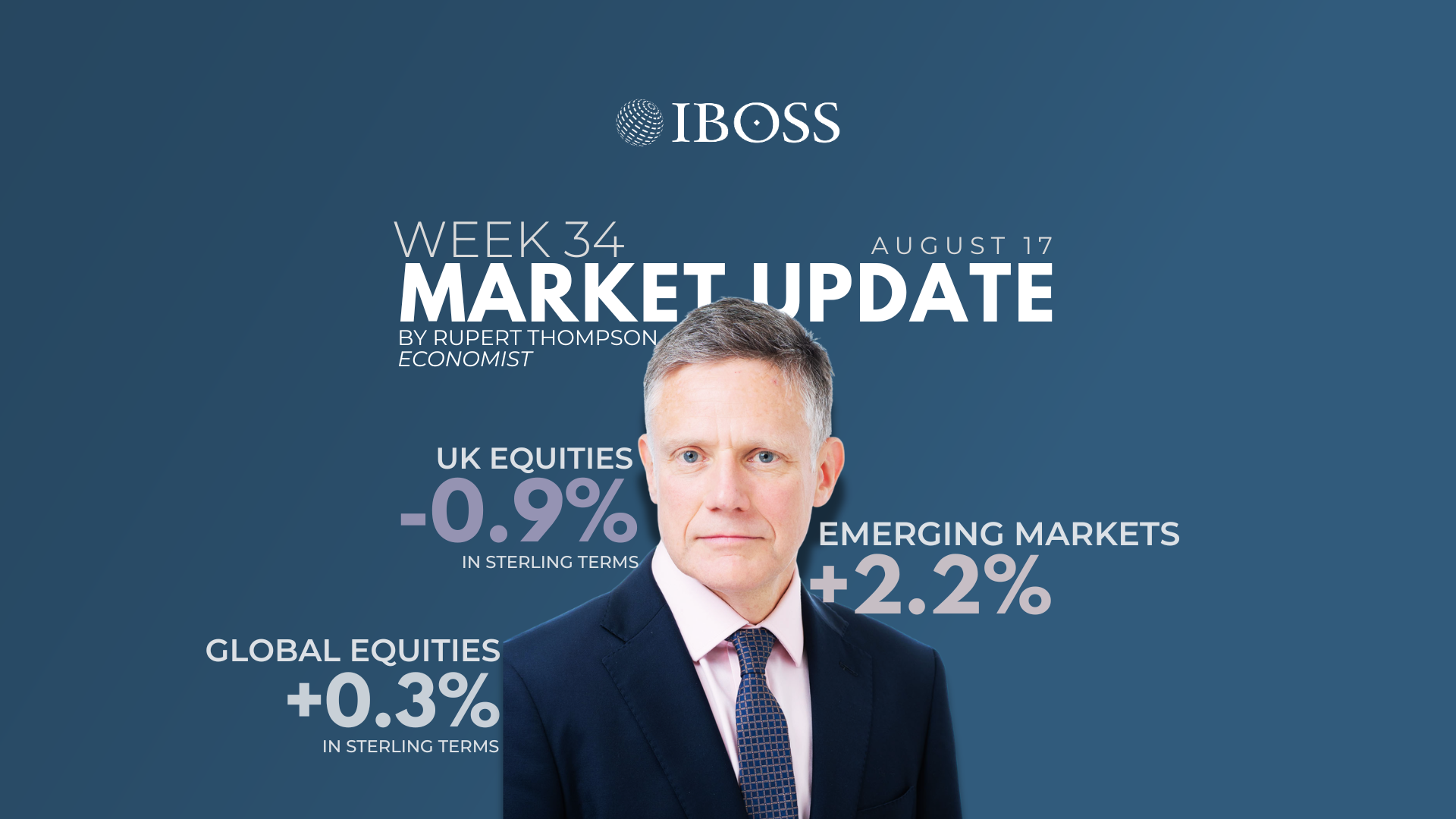
Markets had a quietish week with the main excitement at least in Europe seemingly being the solar eclipse. Global equities built on the previous week’s gains, rising a further 0.7% in local currency and 0.3% in sterling terms.
US equities were little changed while the UK lost 0.9%, giving back a further bit of its recent outperformance, and Europe was also down 0.3%. The increases were left to Japan, which returned 1.9%, and emerging markets which rose 2.2%, buoyed by an 11% gain in Korea which continues its roller-coaster ride.
Bonds, by contrast, unwound some of their recent gain with UK gilts and US Treasuries down 0.6% and 0.1% respectively. Yields edged higher and in the case of the US, the 30-year Treasury yield made the headlines as it touched 5.22%, its highest level since 2001.
The main focus was on the US economic data releases. The August consumer price numbers were the highlight but, in the event, came in broadly as expected. Headline inflation eased slightly to 2.5% from 2.6% while the core rate edged down to 3.4% from 3.5%.
Of more surprise were some unexpectedly weak figures on the consumer. US retail sales posted their first decline for nine months in July and confidence turned down in August. These releases re-awakened concerns that spending might finally be succumbing to the affordability struggles of lower income consumers.
However, with the stock market recently hitting new highs, the likelihood is that wealthier consumers will continue to prop up spending. Still, these numbers had the effect of further reducing the chance that the Fed will raise rates at their meeting next month which had been looking quite likely only a few weeks ago.
Here in the UK, the latest GDP numbers provided a nice surprise with activity seeing an unexpected 0.3% increase in June. This left GDP up 0.4% in the second quarter and 1.1% over the last year. The UK economy – barring a major flare up in the war with Iran or Budget-related hit to confidence – now looks on course to see growth of around 1.25% both this year and next, unchanged from last year.
Japanese GDP data were also released this morning. Activity here grew 0.3% last quarter but was up only a meagre 0.6% on a year earlier. The market, however, is rather more focused on the yen following the joint US-Japanese intervention to prop it up a couple of weeks ago. The jury is still very much out on the success of this operation as the yen has unwound some of its initial surge but remains some way above its pre-intervention low.
Meanwhile, the US and Iran have in recent days resorted to trading unacceptable demands for reparation, rather than outright hostilities, and Trump’s latest threat is to make the Strait of Hormuz a US territory. The 60-day memorandum of understanding expires today and we appear stuck in a stalemate with the two sides still some way from reaching an agreement but neither side wanting a major escalation.
With minimal shipping currently passing through the Strait of Hormuz, crude oil prices are currently $89 per barrel and anticipated by the markets still to be around $85 by year-end. The diversion of Saudi oil from the Strait of Hormuz to the Red Sea, along with the Chinese and US running down their oil inventories, has so far prevented a major shortage of oil.
But with US oil stocks now at very low levels, we are not out of the woods yet – even if the global economy and equity markets have so far managed to shrug off the hit to energy supplies. While crude oil prices are well below their highs earlier in the year, the same cannot be said for other energy prices.
Refining margins have surged, leaving refined fuel prices such as for diesel down less than 10% from their highs. As for European gas prices, they are back up close to their peak as markets start to worry about low inventory levels ahead of the winter.
Still, markets overall seem to have succumbed to the succession of heatwaves and a summer torpor, with equity volatility in the US a far cry from that in Korea and dropping to its lowest level this year. With the key areas of uncertainty we’ve highlighted in the last couple of weeks still very unresolved, the autumn could well see volatility pick up again.
But this coming week, the lull could continue with little major news due for release. The only noteworthy releases are UK labour market and inflation data on Tuesday and Wednesday, Fed meeting minutes on Wednesday and business confidence numbers for the US, Europe and UK on Friday.
This communication is designed for professional financial advisers only and is not approved for direct marketing with individual clients. These investments are not suitable for everyone, and you should obtain expert advice from a professional financial adviser. Investments are intended to be held over a medium to long term timescale, taking into account the minimum period of time designated by the risk rating of the particular fund or portfolio, although this does not provide any guarantee that your objectives will be met. Please note that the content is based on the author’s opinion and is not intended as investment advice. It remains the responsibility of the financial adviser to verify the accuracy of the information and assess whether the OEIC fund or discretionary fund management model portfolio is suitable and appropriate for their customer.
Past performance is not a reliable indicator of future performance. The value of investments and the income derived from them can fall as well as rise, and investors may get back less than they invested.
IBOSS Asset Management Limited is authorised and regulated by the Financial Conduct Authority. Financial Services Register Number 697866.
IBOSS Asset Management Limited is owned by Mattioli Woods Limited is registered in England and Wales at Companies House, Registered number 3140521.
Registered Office is: 2 Sceptre House, Hornbeam Square North, Harrogate, HG2 8PB. Registered in England No: 6427223.
IAM 241.8.26