
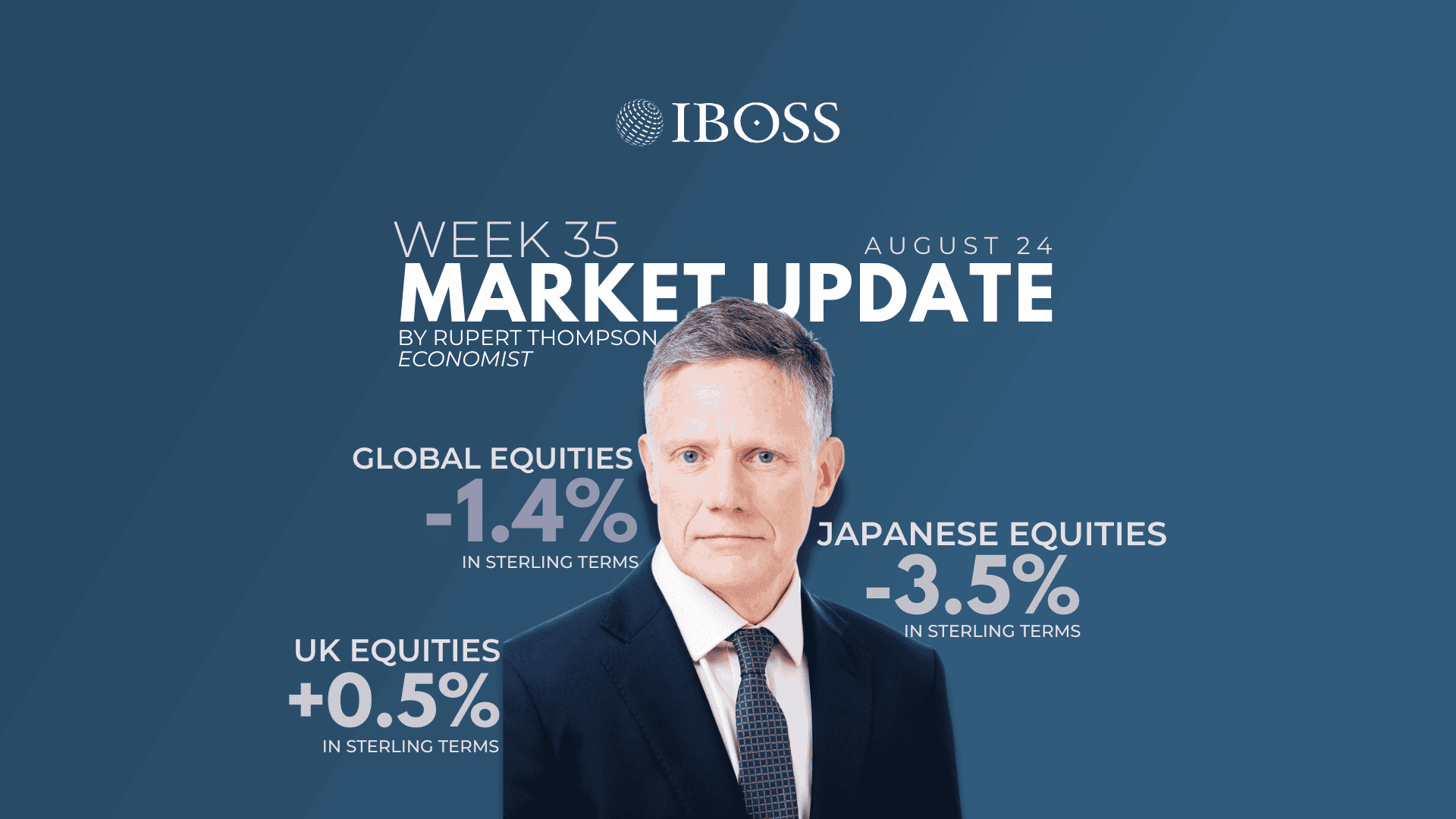
Last week somewhat unexpectedly ended up being all about US Treasuries and partly as a result, global equities reversed some of their gains of the previous couple of weeks, falling 1.1% in local currency and 1.4% in sterling terms. These declines leave markets little changed over the summer and up slightly on their high in early June.
As is the norm nowadays, there was significant divergence in performance between the major regions. Japan fared worse (having performed well the previous week) losing 3.5% in sterling terms but the US also underperformed, losing 2.0%.
UK equities, by contrast, were up 0.5% supported by gains in the materials, energy and healthcare sectors. Emerging markets also fared relatively well, helped by a revival in China which has been a notable laggard of late.
The poor performance of the US was in part down to the tech sector with semiconductor stocks continuing their roller-coaster ride and sliding 5% over the week. But developments in the US Treasury market were the bigger factor.
Longer dated Treasury yields have been trending higher for the last couple of months and 30-year yields edged up further last week, hitting 5.3% – their highest level since 2007. They have been driven up by three main factors:
First, the credibility of Fed policy has come under threat as a result of the cryptic (downright confusing if one was being less charitable) communication style of its new Chair which has cast doubt on how the Fed aims to return inflation to its 2% target.
These worries have been exacerbated by the rebound in oil prices as the Brent crude price is now back up to $93 per barrel. With Operation Epic Fury succeeding only in highlighting the limitations of US military power, the US is now resorting to the economic equivalent. Treasury Secretary Bessent has declared an economic D-Day against Iran, namely the single greatest financial offensive marshalled to isolate Tehran and collapse its economy.
But just as history proved a good guide to how Epic Fury has turned out, it also suggests the Iranian regime is not suddenly going to bend the knee just because of the increasingly dire state of its economy.
Second, there is the underlying dismal US fiscal position although nothing much has changed on this front recently. Even though Bessent is now talking of fiscal consolidation, there appears no serious appetite to take any meaningful action and the budget deficit looks set to remain a high 6% or so of GDP for the foreseeable future. The only real and unfortunate bit of news was that outstanding US Treasury debt has now topped a headline grabbing $40tn, which amounts to 125% of GDP.
Third, the massive AI-related capital spending by the so-called hyperscalers, such as Amazon, Alphabet, Meta and Microsoft, has led these companies to start issuing a ton of long-term debt. This is providing competition to Treasury debt for investor funds and has helped push yields higher.
Still, what has grabbed investor attention most – and not in the way Bessent intended – was his announcement last Wednesday that the US Treasury would double its buy-backs of long-dated Treasury debt from $2bn to at least $4bn. His intervention almost smelt of panic while amounting to little more than peanuts given there is $5.7tn of outstanding long-dated debt.
Bessent’s latest action follows hard on the heels of his recent intervention to support the yen which seems to have been aimed amongst other things at preventing the Bank of Japan from selling US Treasuries. Indeed, the US intervention itself was carried out in a peculiar manner to avoid having to sell Treasuries.
The bottom line is that Bessent has recently done an all too good job of imitating his boss – namely taking actions which, rather than solving the problem, merely serve to highlight the intractability of the underlying issues. Indeed, 30-year Treasury yields ended last week little changed at 5.25%.
Government bond yields, both in the UK it has to be said as well as the US, could well remain under some further upward pressure. But this does not alter the fact that 10-year yields of 4.7% in the US and 5.1% in the UK do now offer attractive returns, assuming one can weather the volatility in prices.
Whereas Bessent’s actions failed to move the Treasury market much, they certainly had an unintended impact elsewhere. Long-standing worries that US fiscal profligacy can only end in the ‘debasement’ of the US currency were re-ignited and led to the dollar falling 1% over the week, gold rising 5% and bitcoin jumping over 20% (although it still remains down 10% year-to-date).
As to whether the rise in bond yields constitutes a major threat to equity markets, our view is that it does not. It could well trigger some volatility and is undoubtedly a drag but looks unlikely to cause a big reversal. The reason is twofold: strong growth in corporate earnings remains a big tailwind and equities are less expensive than they were – the global P/E ratio is back down to 17.0 from last year’s high of 20.0.
In other depressingly familiar news, tariffs reared their ugly head again. Trade negotiations between the US and Canada have broken down, prompting the US to introduce a 50% tariff on Canadian imports and Canada promising dollar for dollar reciprocal tariffs. We have been here before with the US and China and most likely, as was the case back then, some kind of face-saving deal will eventually allow some partial backing down.
More encouraging were the business confidence numbers for August. Sentiment in the US improved further to a surprisingly high level. And in the UK and Europe, where optimism remains lower, it at least held onto its July gains and is well up on the lows of the spring.
Here in the UK, the main focus was on the latest labour market and inflation numbers with no big surprises in either. The labour market appears to be continuing to weaken but not dramatically so, while wage gains continue to moderate with private sector wage growth slowing to 2.8% in June.
Meanwhile, headline inflation rose to 2.9% in July from 2.6% and looks set to head up to 3.5% or so over coming months, while core inflation was unchanged at 2.6% last month.
On the growth front, Andy Burnham – or maybe it was the heatwaves – has led to a revival in consumer confidence with optimism hitting a two-year high in August. None of these numbers have changed the market’s view that the Bank of England will hold off raising rates in September but will do so before year-end.
This coming week, the highlights will be the US inflation numbers and Nvidia’s earnings on Wednesday and a speech by Fed Chair Kevin Warsh on Friday at the annual central bank shindig at Jackson Hole in Wyoming.
But this coming week, the lull could continue with little major news due for release. The only noteworthy releases are UK labour market and inflation data on Tuesday and Wednesday, Fed meeting minutes on Wednesday and business confidence numbers for the US, Europe and UK on Friday.
This communication is designed for professional financial advisers only and is not approved for direct marketing with individual clients. These investments are not suitable for everyone, and you should obtain expert advice from a professional financial adviser. Investments are intended to be held over a medium to long term timescale, taking into account the minimum period of time designated by the risk rating of the particular fund or portfolio, although this does not provide any guarantee that your objectives will be met. Please note that the content is based on the author’s opinion and is not intended as investment advice. It remains the responsibility of the financial adviser to verify the accuracy of the information and assess whether the OEIC fund or discretionary fund management model portfolio is suitable and appropriate for their customer.
Past performance is not a reliable indicator of future performance. The value of investments and the income derived from them can fall as well as rise, and investors may get back less than they invested.
IBOSS Asset Management Limited is authorised and regulated by the Financial Conduct Authority. Financial Services Register Number 697866.
IBOSS Asset Management Limited is owned by Mattioli Woods Limited is registered in England and Wales at Companies House, Registered number 3140521.
Registered Office is: 2 Sceptre House, Hornbeam Square North, Harrogate, HG2 8PB. Registered in England No: 6427223.
IAM 247.8.26