
All Change at the Fed
At the last FOMC meeting, the Federal Reserve left interest rates unchanged. Rather than calming bond markets, however, what followed was a highly unusual press conference that sent longer dated bonds into an almost unprecedented tailspin. New Fed Chair Kevin Warsh failed to provide a clear outline of the Fed’s reaction function, withdrew forward guidance and hinted that, after 2026, post-FOMC press conferences could also become a thing of the past. He also failed to reassure investors over the Fed’s commitment to tackling inflation, although other policymakers have since sought to calm markets by reiterating that the Committee will act if necessary.
There is an art to saying very little while still providing markets with confidence. On this early occasion in his tenure, Warsh did neither. Instead, in our view, the Chair’s comments provided less guidance than markets had expected and contributed to increased market volatility.
The more important question, however, is what a less communicative Federal Reserve means for bond markets going forward. Somewhat counterintuitively, we remain relatively positive. If the Fed genuinely moves away from detailed forward guidance and becomes less inclined to explain every decision, markets are likely to experience greater volatility and less consensus positioning built around central bank messaging. While that may create a more uncertain backdrop, periods of volatility may create additional opportunities, they can also increase investment risk and there is no guarantee that managers will benefit from such conditions.
What’s Really Happening to Oil?
The headlines continue to be dominated by the US-Iran conflict, with an endless stream of claims and counterclaims from two sides that neither trust nor believe each other. Both are intent on convincing domestic audiences that they are winning and that history is on their side. As we discussed last month, this conflict arguably began in 1979 rather than 2026, and, in our view, it is unlikely to be truly resolved without regime change in Iran. There are currently no signs of that happening.
Markets have become increasingly numb to declarations of imminent victory or President Trump’s latest assertion that, if Iran had refused to negotiate, “We had an attack that would have been the biggest attack since World War II. It would have been disastrous for them.” Whether or not such statements are intended as deterrence or domestic political messaging, they have had only a fleeting impact on financial markets.
The more interesting story is what is happening beneath the headlines. Despite continued warnings from oil executives about the risks of higher prices, their capital allocation decisions tell a much more cautious story. Rather than returning their recent windfall to shareholders, the oil supermajors are prioritising debt reduction, restructuring and strengthening their balance sheets. That suggests they are preparing for the next downturn rather than positioning for a prolonged period of exceptionally high oil prices.
Such financial discipline has historically been rare in the energy sector, where periods of high prices have often encouraged overinvestment and generous shareholder distributions. The fact that many of the largest producers are now taking a similar approach is revealing. Their actions imply they are more concerned about lower oil prices over the medium term than a return to the extreme highs seen during previous geopolitical shocks.
We are far from oil experts, but we can be confident that the management teams running the world’s largest energy companies are. Their actions suggest that, barring a significant and unexpected escalation in geopolitical disruption, we believe lower oil prices are the more likely outcome over the coming months. If that proves correct, it will help reduce the energy component of inflation, easing pressure on interest rates and providing a supportive backdrop for global growth, particularly in Asia and emerging markets, where many economies remain heavily dependent on imported energy.
AI & Tech Fear & Greed Writ Large
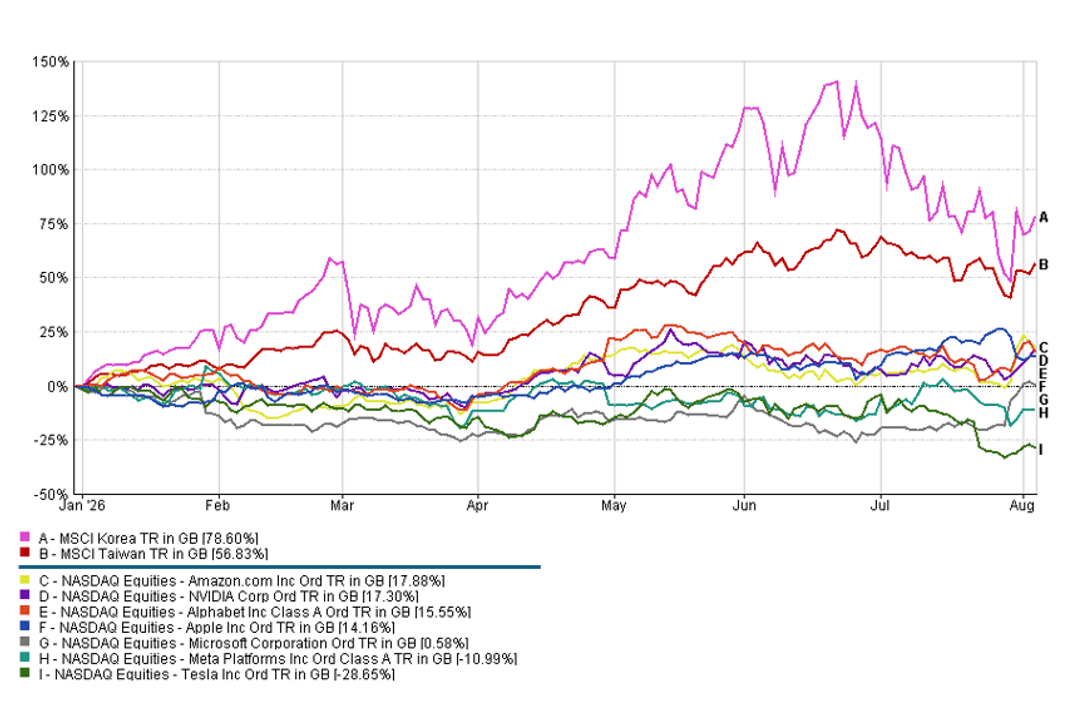
Perhaps even more than the debate over the Strait of Hormuz, questions around AI valuations seem never-ending. Yet 2026 has reminded investors that the AI opportunity extends well beyond the Magnificent Seven. While the US technology giants continue to dominate headlines, Korea and Taiwan, home to many of the world’s leading semiconductor manufacturers, have significantly outperformed most of them this year. The lesson is simple: some of the biggest winners from an investment theme are often the companies supplying the tools, not just those using them. At the same time, treating the Magnificent Seven as a single investment theme is becoming increasingly unhelpful. While Amazon is up almost 18% year to date, Tesla has fallen by nearly a third since December 2025, highlighting just how different the fortunes of these companies have become. We continue to hold technology exposure across multiple geographies, but, echoing many client comments, remain cautious about businesses that appear almost impossible to value. With breakthroughs occurring almost daily, this is a sector that demands humility. There is simply too much that remains unknown, both about future business models and, ultimately, how they should be valued.
The Mag 7, Korea & Taiwan Performance Line Chart- 2025 to 05/08/2026
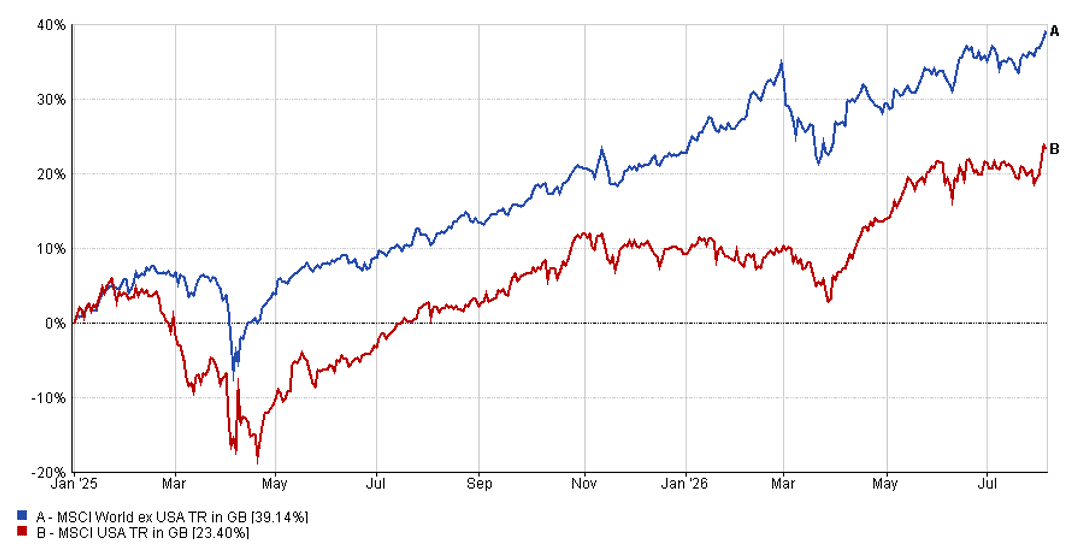
Performance Line Chart- 2025 to 05/08/2026
Finally, we revisit a chart we have been highlighting since Donald Trump returned to office in November 2024. Whatever your views on the conflicts he starts or stops, whether tariffs ultimately prove positive or negative for the US economy, or the administration’s attempts to reshape America’s place in the global order, one investment outcome has been remarkably consistent: most of the world’s equity markets have outperformed the US during his second term. Assuming much of the current uncertainty persists throughout President Trump’s second term, we expect the same broad outcome: the US should remain an attractive market, but not to the exceptional extent it was before November 2024. Instead, we believe the investment playing field will continue to level, creating a richer opportunity set across the rest of the world.
IBOSS Performance Update 31/07/2026
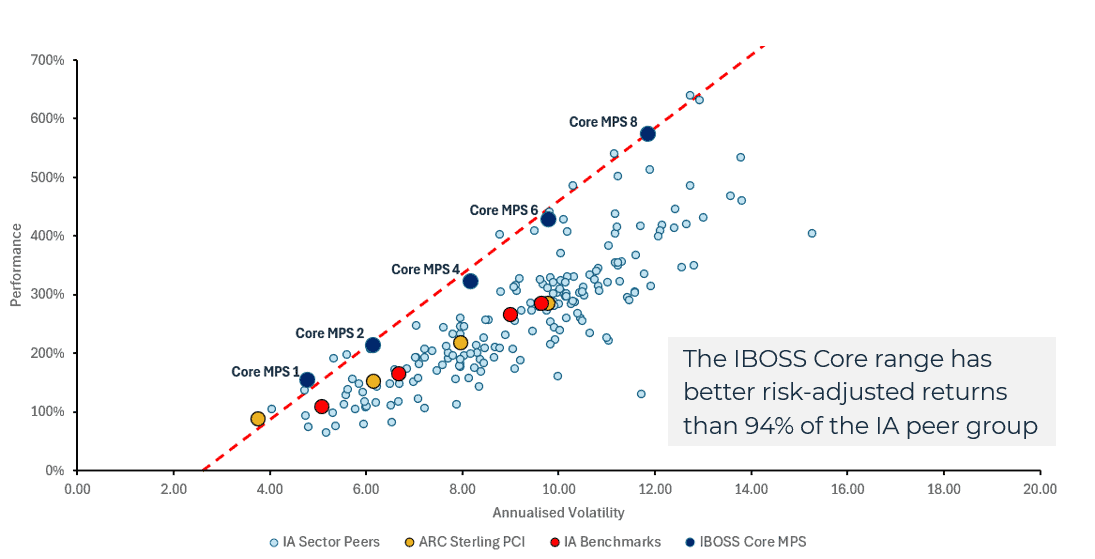
Fig1: Performance & Volatility – 01.11.2008 > 31.07.2026
The IBOSS ranges performed strongly in July, with the majority of ranges delivering positive outperformance over the month Particularly encouraging was the resilience shown by several higher-risk portfolios during a period when the IA Flexible Investment sector declined by 0.7%. In contrast, Core 8, Passive 8, and Decumulation 8 generated returns of 0.9%, 0.5%, and 1.2%, respectively.
While one month’s performance represents only a short-term snapshot, it has made a meaningful contribution to longer-term results. As the chart above illustrates, the IBOSS Core portfolios now deliver higher risk-adjusted returns compared with 94% of the IA peer group since launch (Fig1).
This new milestone highlights how quickly relative performance can evolve and reinforces the benefits of maintaining a fully diversified portfolio. Diversification not only helps to reduce portfolio volatility over time but can also enhance returns by capturing opportunities across a broader range of asset classes and market environments.
Key contributors to returns this month included:
Several asset classes made notable positive contributions to portfolio returns during July:
- UK Equities: UK equities enjoyed a particularly strong month, with the FTSE 100 returning 3.2% and the FTSE 250 delivering an impressive 6.65%. This broad-based rally provided a meaningful boost to portfolios with UK equity exposure.
- Commodities: Commodity markets recovered well in July, with strength in the energy complex (particularly oil-related companies) driving returns after a volatile start to the year. The Core range’s allocation to the JPM Natural Resources Fund, which has significant exposure to global energy and mining businesses, benefited from this environment, returning 5.77% during the month.
- Asian & Emerging Market Equities: While headlines remained dominated by weakness in parts of Asia most notably South Korea, where AI-related stocks have driven a sharp correction and the market is now down around 18% year to date. However, the broader emerging markets universe told a different story. Emerging Markets and Asia encompass a diverse range of economies that often perform very differently from one another. Chinese equities, which have largely lagged global markets this year, rebounded strongly in July with gains of 7.5%, while Latin American equities also delivered solid returns of approximately 3.5%, opportunities many active managers, and some indices, were exposed to.
The data presented covers a limited time period due to the context of this metric. Short-term performance may not be indicative of long-term trends. Investors should consider longer-term performance data and other relevant factors before making investment decisions.
This communication is designed for professional financial advisers only and is not approved for direct marketing with individual clients. These investments are not suitable for everyone, and you should obtain expert advice from a professional financial adviser. Investments are intended to be held over a medium to long term timescale, taking into account the minimum period of time designated by the risk rating of the particular fund or portfolio, although this does not provide any guarantee that your objectives will be met. Please note that the content is based on the author’s opinion and is not intended as investment advice. It remains the responsibility of the financial adviser to verify the accuracy of the information and assess whether the OEIC fund or discretionary fund management model portfolio is suitable and appropriate for their customer.
Past performance is not a reliable indicator of future performance. The value of investments and the income derived from them can fall as well as rise, and investors may get back less than they invested.
IBOSS Asset Management Limited is authorised and regulated by the Financial Conduct Authority. Financial Services Register Number 697866.
IBOSS Asset Management Limited is owned by Mattioli Woods Limited is registered in England and Wales at Companies House, Registered number 3140521.
Registered Office is: 2 Sceptre House, Hornbeam Square North, Harrogate, HG2 8PB. Registered in England No: 6427223.
Approved August 2026
IAM 240.8.26