
Markets continue to navigate an environment characterised by slowing but positive economic growth, easing inflation, higher interest rates and elevated geopolitical uncertainty. While corporate earnings and consumer activity have generally remained supportive, investors face a backdrop where geopolitical events, fiscal policy decisions and structural technological change are increasingly driving market outcomes.
Economic Growth
Global economic growth remains positive, albeit below long-term trend levels. The United States continues to demonstrate resilience, supported by relatively robust consumer spending and labour market conditions. By contrast, Europe continues to struggle with weaker industrial activity, political uncertainty and the lingering effects of higher energy costs.
Elsewhere, Asia and parts of Latin America remain important sources of global growth, with technology investment, infrastructure spending and domestic consumption supporting economic activity. Although recession concerns have diminished, growth remains fragile and highly dependent on inflation continuing its downward trajectory without causing a material deterioration in employment.
Inflation & Central Banks
Inflation has fallen significantly from its post-pandemic highs, but the final stage of returning inflation to central bank targets is proving more difficult. Services inflation, wage pressures and energy costs continue to create stickier inflationary dynamics than policymakers would ideally like.
As a consequence, central banks remain cautious. Markets had hoped for a more accommodative monetary backdrop by now, but the reality is that interest rates are likely to remain elevated for longer. The Federal Reserve appears to have little choice but to remain vigilant, even if tighter policy is politically inconvenient and potentially unpopular in some quarters.
For investors, this reinforces the view that markets are unlikely to return to the ultra-low interest rate environment that dominated much of the previous decade. Portfolio construction must therefore continue to account for a world where the cost of capital is meaningfully higher than investors became accustomed to between 2009 and 2021.
Geopolitics Remains Centre Stage
The war in Ukraine remains a protracted conflict with no obvious pathway to either a near or longer-term resolution. Beyond the human impact, the conflict continues to influence European defence policy, fiscal spending priorities and energy security planning.
At the same time, tensions involving Iran remain a key geopolitical risk. Any escalation has the potential to disrupt major energy supply routes, increase oil price volatility and reignite inflationary pressures. We believe that meaningful progress is more likely to occur following the US midterm election cycle than beforehand.
The investment backdrop is now increasingly shaped by two major geopolitical flashpoints, both of which have direct implications for energy prices, inflation expectations and market sentiment. As a result, geopolitical risk can no longer be viewed as a temporary market concern but rather a structural feature of the investment landscape.
Politics & Fiscal Policy
Political developments are becoming increasingly influential for financial markets.
Across developed economies, governments continue to walk a fine line between supporting economic growth and managing already elevated debt burdens. However, there appears to be limited political appetite across much of the developed world to materially reduce spending or address budget deficits in a meaningful way.
This is perhaps most evident in the United States, where fiscal discipline remains noticeably absent from the mainstream political debate. In our view, bond markets may ultimately prove to be the ‘adult in the room’, imposing discipline through higher borrowing costs if governments continue to spend beyond their means while servicing debt at increasingly expensive interest rates.
European politics also remains a developing theme. Support for nationalist and right-leaning political parties continues to grow across a number of major economies. Recent electoral performances by the AfD in Germany highlight this trend, while France’s Rassemblement National continues to poll strongly and arguably appears closer to national power than its German counterpart.
Whilst political developments do not always translate directly into investment outcomes, the direction of travel is increasingly difficult to ignore and could have important implications for fiscal policy, regulation and international cooperation over the coming years.
Energy Markets
Energy markets remain highly sensitive to geopolitical developments. The combination of ongoing conflict in Eastern Europe and instability across parts of the Middle East creates a persistent risk of supply disruptions and greater price volatility.
Although energy prices remain below the extremes experienced in recent years, investors should not underestimate the speed with which geopolitical events can alter inflation expectations and economic forecasts.
Artificial Intelligence: Opportunity and Risk
Artificial intelligence continues to be one of the most significant structural investment themes in global markets. Investment in AI infrastructure, data centres, semiconductors and supporting technologies remains substantial and is expected to drive productivity improvements across multiple sectors over the coming decade.
However, while the investment opportunity is considerable, concerns surrounding AI safety, governance and regulation are becoming increasingly prominent. A growing number of industry leaders, academics and former developers have publicly highlighted concerns around the pace of advancement relative to the regulatory framework surrounding these technologies.
In our view, the debate around AI has now moved beyond whether it will transform industries and economies. Instead, the more important question is whether regulation and oversight can keep pace with innovation. History suggests regulation is often reactive rather than proactive, and it may take a significant “near miss” or real-world failure before policymakers take more decisive action.
This does not diminish the long-term opportunity, but it does suggest investors should be prepared for periods where regulatory risks and public concerns create volatility within the sector.
IBOSS Performance Update 31/08/2026
All IBOSS portfolios delivered positive returns in August. While there was some short-term underperformance relative to benchmarks, longer-term performance remains robust and continues to compare favourably against peers.
The increased volatility and changing market environment, which have more recently favoured active management, have begun to be reflected in portfolio outcomes. This has been particularly evident within the Passive MPS range, which has trailed the Core MPS portfolios both year-to-date and, more notably, during August.
That said, all IBOSS portfolio ranges are constructed with diversification at their core, providing multiple sources of potential return. The market conditions experienced since the beginning of 2025 have reinforced the benefits of broader global diversification, with a wider range of regions contributing to returns rather than the more concentrated environment previously characterised by US exceptionalism.
Performance Line Chart – Rest of World vs US (to 14/09/2026)
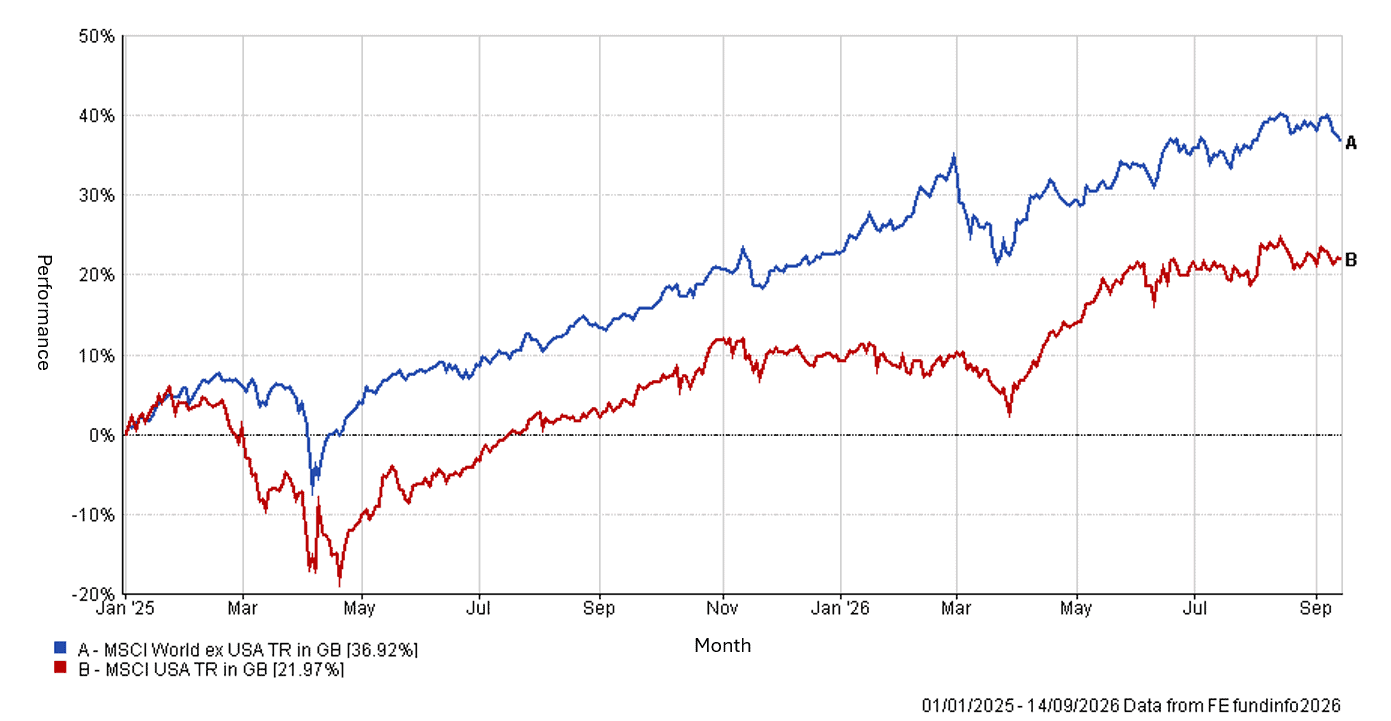
We therefore believe portfolios remain well positioned as we move towards the end of 2026. While we expect market noise and elevated volatility to persist, these conditions can continue to create opportunities for active asset allocation and diversified portfolio construction, both of which remain central to our investment approach.
The data presented covers a limited time period due to the context of this metric. Short-term performance may not be indicative of long-term trends. Investors should consider longer-term performance data and other relevant factors before making investment decisions.
This communication is designed for professional financial advisers only and is not approved for direct marketing with individual clients. These investments are not suitable for everyone, and you should obtain expert advice from a professional financial adviser. Investments are intended to be held over a medium to long term timescale, taking into account the minimum period of time designated by the risk rating of the particular fund or portfolio, although this does not provide any guarantee that your objectives will be met. Please note that the content is based on the author’s opinion and is not intended as investment advice. It remains the responsibility of the financial adviser to verify the accuracy of the information and assess whether the OEIC fund or discretionary fund management model portfolio is suitable and appropriate for their customer.
Past performance is not a reliable indicator of future performance. The value of investments and the income derived from them can fall as well as rise, and investors may get back less than they invested.
IBOSS Asset Management Limited is authorised and regulated by the Financial Conduct Authority. Financial Services Register Number 697866.
IBOSS Asset Management Limited is owned by Mattioli Woods Limited is registered in England and Wales at Companies House, Registered number 3140521.
Registered Office is: 2 Sceptre House, Hornbeam Square North, Harrogate, HG2 8PB. Registered in England No: 6427223.
IAM 261.9.26