
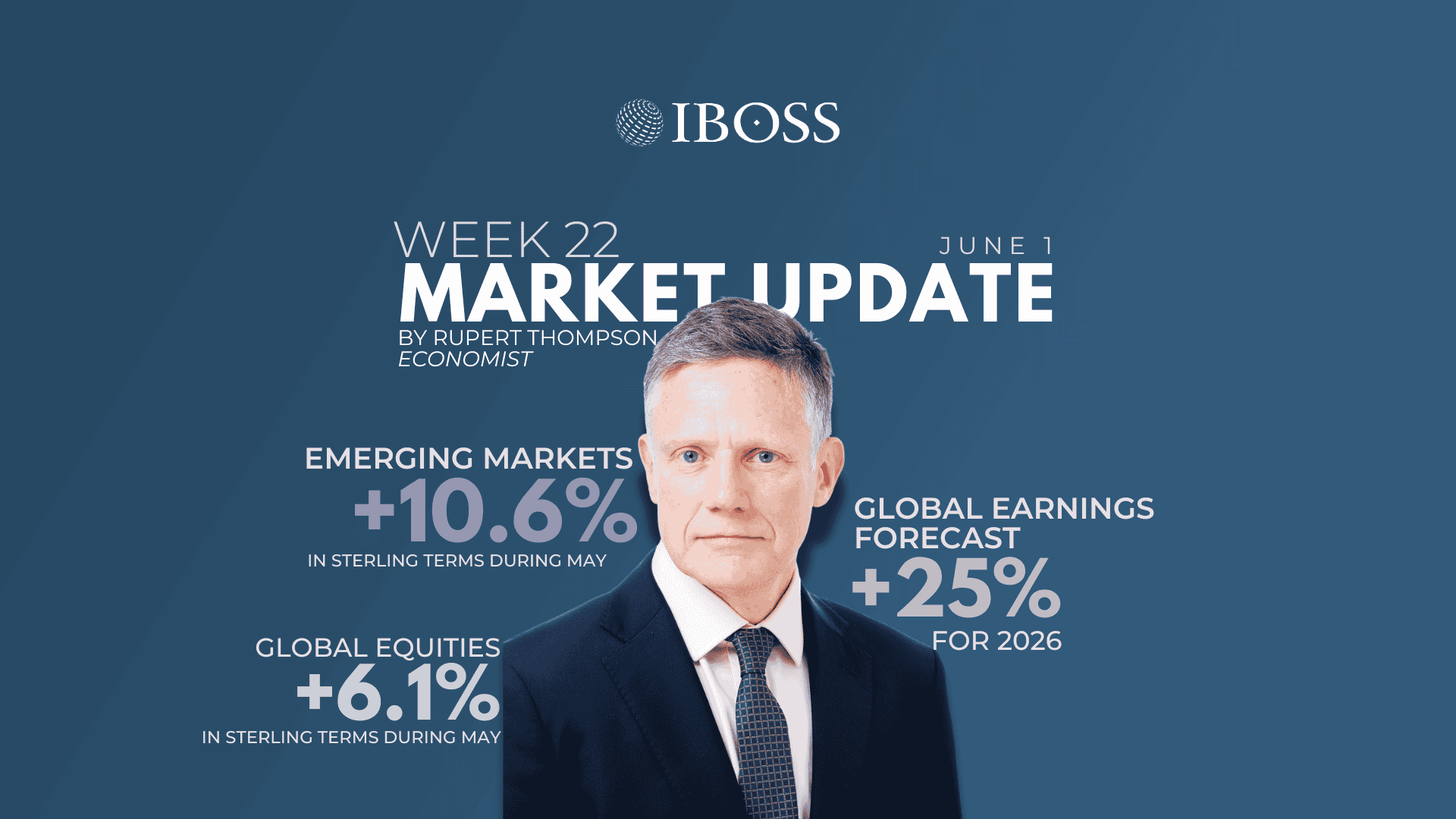
Equity markets remained in buoyant mood last week with global equities up around 1.5% in both local currency and sterling terms. This left markets over May as a whole up a strong 5.4% in local currency terms and 6.1% in sterling terms.
Emerging markets led the gains, rising 3.6% over the week and 10.6% over the month in sterling terms, beating the gains of US equities which were up 1.2% and 6.0% respectively. UK stocks lagged, falling 0.3% last week and up only a modest 1.2% over the month. They suffered from the lack of exposure to the tech sector, which gained as much as 14.5% in May, and an overexposure to energy stocks which retreated 4.6%.
The strong performance of global equities is down to two main factors – the growing conviction that Iran and the US are getting close to some kind of peace deal and exceptionally strong corporate earnings growth.
As regards the former, we clearly seem to be edging closer towards agreement of a memorandum of understanding – with the US proclaiming every other day that they are close to a deal, which would involve a re-opening of the Strait of Hormuz over coming weeks.
However, it still seems to be a case of two or three steps forward and one step back, given the renewed skirmishes between the two sides and increased fighting in Lebanon between Israel and Hizbollah. The process is further being complicated by vehement criticism of the likely deal, both by various senior Republicans in the US and hardliners in Iran.
The oil market has certainly taken heart from the latest developments, with the Brent crude price dropping a further 10% last week to $94 per barrel. That said, it is only assuming quite a slow resumption of energy supplies with the oil price still anticipated to be $85 by year-end, well above its pre-war level of $65-70.
As for corporate earnings, estimates have been revised up substantially in recent months. Global earnings are now forecast to grow 25% this year, up from an estimated 15% at the start of the year and the 10% pace seen last year. The upward revisions have been led by emerging markets and to a lesser extent the US, with gains of 55% and 25% respectively now forecast for the current year.
But it is the tech sector – particularly semiconductor companies – which has been the big driver of these revisions. And the global semiconductor sector has surged as a result, gaining as much as 20% in May and swamping the 7% gain in the Magnificent Seven. Indeed, two more of the major chip players – the US company Micron and Korean company SK Hynix – have just seen their valuations hit the $1 trillion mark even without needing to shoot for the moon like some others.
One effect of this is that emerging markets are now even more dominated by just a few stocks than the US. The largest three companies (TSMC, Samsung and SK Hynix) – at end-April, even before last month’s outsized gains – accounted for 24% of the emerging market index. Nvidia, Apple and Microsoft by comparison made up 19% of the US index.
The recent surge in prices of these titans in the chip world has come on the back of massive upward revisions to their earnings and means even now their price-earnings ratios are not looking expensive. But this does not mean they come without risk. It is just that the risk relates to the sustainability of the current earnings bonanza rather than their valuations.
Near term for sure, the boom in AI-related spending looks all set to continue. Further out, however, there remains considerable uncertainty over how the whole AI theme plays out – not only at the macro level in terms of the impact on growth, jobs and profits but also at the company level in terms of who are the ultimate winners.
The market’s view on who will be the big AI winners and losers has changed considerably. The Magnificent Seven were presumed to be the big AI story only a year or two ago but now the chip companies are the AI darlings. With many of the big players competing against each other, it is far from clear which of the AI model providers, the Magnificent Seven or the chip companies will come out on top.
All this highlights the uncertainties still prevailing over anything AI-related and is reason not to get too carried away with the latest hot AI theme, sector or company. Continued exposure to this area is certainly warranted but in a diversified manner. With stock concentration now so high in both the US and emerging markets, we believe there is good reason to gain much of one’s exposure to these regions via actively managed funds which can limit the risks rather than via a passive ETF which can’t.
Returning to the here and now, bonds also had a good week. They took heart from the fall in oil prices with UK gilts and US Treasuries both returning 0.7% as yields edged lower. Fears of interest rate hikes have moderated in the UK with the market now expecting no change at the BOE meeting later this month and only one or possibly two increases later in the year – rather than the three hikes feared back in March.
Fears of rate hikes have also eased elsewhere but less so. The ECB is still expected to raise rates at least twice with the first 0.25% move occurring later this month. And in the US, the market still anticipates the Fed increasing rates once, a far cry from the three cuts expected earlier in the year.
The latest inflation numbers highlighted the problem the new Fed Chair Kevin Warsh will have in persuading his fellow Fed members to do Trump’s bidding and cut rates. The Fed’s favoured inflation measure showed the headline rate rising to 3.8% last month and the core rate edging up to 3.3% – both well above the central bank’s 2% target.
First quarter US growth was revised down last week to a sluggish annualised 1.6% pace. But underlying growth remained rather stronger at around 2.5% and there is little sign that the economy needs to be supported by cutting rates.
This coming week is light on macro data. US payrolls for May on Friday will be the main focus although we also have May numbers for Eurozone inflation out tomorrow.
This communication is designed for professional financial advisers only and is not approved for direct marketing with individual clients. These investments are not suitable for everyone, and you should obtain expert advice from a professional financial adviser. Investments are intended to be held over a medium to long term timescale, taking into account the minimum period of time designated by the risk rating of the particular fund or portfolio, although this does not provide any guarantee that your objectives will be met. Please note that the content is based on the author’s opinion and is not intended as investment advice. It remains the responsibility of the financial adviser to verify the accuracy of the information and assess whether the OEIC fund or discretionary fund management model portfolio is suitable and appropriate for their customer.
Past performance is not a reliable indicator of future performance. The value of investments and the income derived from them can fall as well as rise, and investors may get back less than they invested.
IBOSS Asset Management Limited is authorised and regulated by the Financial Conduct Authority. Financial Services Register Number 697866.
IBOSS Asset Management Limited is owned by Mattioli Woods Limited is registered in England and Wales at Companies House, Registered number 3140521.
Registered Office is: 2 Sceptre House, Hornbeam Square North, Harrogate, HG2 8PB. Registered in England No: 6427223.
IAM 229.8.26